Only someone who values land enough to farm a hillside for more than thirty years could write about a wild place so lovingly. Wendell Berry just as easily steps into Kentucky's Red River Gorge and makes the observations of a poet as he does step away to view his subject with the keen, unflinching eye of an essayist. The inimitable voice of Wendell Berry—at once frank and lovely—is our guide as we explore this unique wilderness.
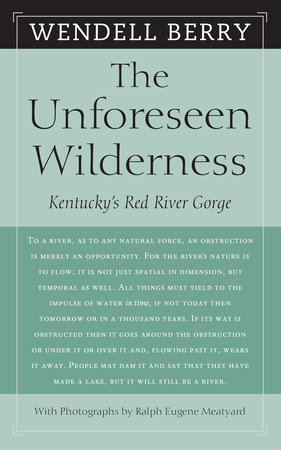
Located in eastern Kentucky and home to 26,000 acres of untamed river, rock formations, historical sites, unusual vegetation and wildlife, the Gorge very nearly fell victim to a man–made lake thirty years ago. "No place is to be learned like a textbook," Berry tells us, and so through revealing the Gorge's corners and crevices, its ridges and rapids, his words not only implore us to know more but to venture there ourselves. Infused with his very personal perspective and enhanced by the startling photographs of Ralph Eugene Meatyard, The Unforeseen Wilderness draws the reader in to celebrate an extraordinary natural beauty and to better understand what threatens it.
WENDELL BERRY, an essayist, novelist, and poet, has been honored with the T. S. Eliot Prize, the Aiken Taylor Award for Modern American Poetry, the John Hay Award of the Orion Society, and the Dayton Literary Peace Prize Richard C. Holbrooke Distinguished Achievement Award, among other distinctions. In 2010, he was awarded the National Humanities Medal by President Barack Obama, and in 2016, he was the recipient of the Ivan Sandrof Life Achievement Award from the National Book Critics Circle. Berry lives with his wife, Tanya Berry, on their farm in Henry County, Kentucky.
"Berry continues to offer a compelling vision of the good and the true life." —The Boston Globe
"Berry is the prophetic American voice of our day." —The Christian Science Monitor
"Berry enjoins us to look at common parts of creation—trees, rivers, and birds—but meditates upon them with such grace and insight as to ensure that we will never see them as commonplace again." —Splendid Magazine
Only someone who values land enough to farm a hillside for more than thirty years could write about a wild place so lovingly. Wendell Berry just as easily steps into Kentucky's Red River Gorge and makes the observations of a poet as he does step away to view his subject with the keen, unflinching eye of an essayist. The inimitable voice of Wendell Berry—at once frank and lovely—is our guide as we explore this unique wilderness.
Located in eastern Kentucky and home to 26,000 acres of untamed river, rock formations, historical sites, unusual vegetation and wildlife, the Gorge very nearly fell victim to a man–made lake thirty years ago. "No place is to be learned like a textbook," Berry tells us, and so through revealing the Gorge's corners and crevices, its ridges and rapids, his words not only implore us to know more but to venture there ourselves. Infused with his very personal perspective and enhanced by the startling photographs of Ralph Eugene Meatyard, The Unforeseen Wilderness draws the reader in to celebrate an extraordinary natural beauty and to better understand what threatens it.
Creators
WENDELL BERRY, an essayist, novelist, and poet, has been honored with the T. S. Eliot Prize, the Aiken Taylor Award for Modern American Poetry, the John Hay Award of the Orion Society, and the Dayton Literary Peace Prize Richard C. Holbrooke Distinguished Achievement Award, among other distinctions. In 2010, he was awarded the National Humanities Medal by President Barack Obama, and in 2016, he was the recipient of the Ivan Sandrof Life Achievement Award from the National Book Critics Circle. Berry lives with his wife, Tanya Berry, on their farm in Henry County, Kentucky.
"Berry continues to offer a compelling vision of the good and the true life." —The Boston Globe
"Berry is the prophetic American voice of our day." —The Christian Science Monitor
"Berry enjoins us to look at common parts of creation—trees, rivers, and birds—but meditates upon them with such grace and insight as to ensure that we will never see them as commonplace again." —Splendid Magazine