Close Modal

The Odyssey

Author Homer
Look inside
Hardcover (Paper-over-Board, no jacket)
5.19"W x 7.31"H x 0.64"D   | 7 oz | 24 per carton
On sale May 26, 2026 | 160 Pages | 9798217320134
Age 10 and up
Reading Level: Lexile 880L

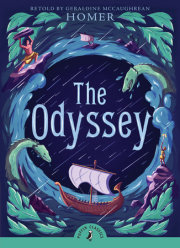
An action-packed retelling of Homer’s The Odyssey in an edgy, deluxe hardcover featuring metallic foil effects and embossing on the jacket! Read it ahead of Christopher Nolan’s highly anticipated film, coming July 2026.

After ten years of war, Odysseus turns his back on Troy and sets sail for home. But his voyage takes another ten years and he must face many dangers—Polyphemus the greedy one-eyed giant, Scylla the six-headed sea monster, and even the wrath of the gods themselves—before he is reunited with his wife and son.

Brilliantly retold by award-winning author Geraldine McCaughrean, this accessible adaptation brings Homer’s timeless tale to life with clear, engaging language and fast-paced storytelling in a shorter page count.
Homer was a Greek poet, recognized as the author of the great epics, the Iliad, the story of the siege of Troy, and the Odyssey, the tale of Ulysses’s wanderings. View titles by Homer
Available for sale exclusive:
•     Canada
•     Guam
•     Minor Outl.Ins.
•     North Mariana
•     Philippines
•     Puerto Rico
•     Samoa,American
•     US Virgin Is.
•     USA

Available for sale non-exclusive:
•     Afghanistan
•     Aland Islands
•     Albania
•     Algeria
•     Andorra
•     Angola
•     Anguilla
•     Antarctica
•     Argentina
•     Armenia
•     Aruba
•     Azerbaijan
•     Bahrain
•     Belarus
•     Benin
•     Bhutan
•     Bolivia
•     Bonaire, Saba
•     Bosnia Herzeg.
•     Bouvet Island
•     Brazil
•     Burkina Faso
•     Burundi
•     Cambodia
•     Cameroon
•     Cape Verde
•     Centr.Afr.Rep.
•     Chad
•     Chile
•     China
•     Colombia
•     Comoro Is.
•     Congo
•     Cook Islands
•     Costa Rica
•     Cuba
•     Curacao
•     Dem. Rep. Congo
•     Djibouti
•     Dominican Rep.
•     Ecuador
•     Egypt
•     El Salvador
•     Equatorial Gui.
•     Eritrea
•     Ethiopia
•     Faroe Islands
•     Fren.Polynesia
•     French Guinea
•     Gabon
•     Georgia
•     Greenland
•     Guadeloupe
•     Guatemala
•     Guinea Republic
•     Guinea-Bissau
•     Haiti
•     Heard/McDon.Isl
•     Honduras
•     Hong Kong
•     Iceland
•     Indonesia
•     Iran
•     Iraq
•     Israel
•     Ivory Coast
•     Japan
•     Jordan
•     Kazakhstan
•     Kuwait
•     Kyrgyzstan
•     Laos
•     Lebanon
•     Liberia
•     Libya
•     Liechtenstein
•     Macau
•     Macedonia
•     Madagascar
•     Maldives
•     Mali
•     Marshall island
•     Martinique
•     Mauritania
•     Mayotte
•     Mexico
•     Micronesia
•     Moldavia
•     Monaco
•     Mongolia
•     Montenegro
•     Morocco
•     Myanmar
•     Nepal
•     New Caledonia
•     Nicaragua
•     Niger
•     Niue
•     Norfolk Island
•     North Korea
•     Norway
•     Oman
•     Palau
•     Palestinian Ter
•     Panama
•     Paraguay
•     Peru
•     Qatar
•     Reunion Island
•     Russian Fed.
•     Rwanda
•     Saint Martin
•     San Marino
•     SaoTome Princip
•     Saudi Arabia
•     Senegal
•     Serbia
•     Singapore
•     Sint Maarten
•     South Korea
•     South Sudan
•     St Barthelemy
•     St.Pier,Miquel.
•     Sth Terr. Franc
•     Sudan
•     Suriname
•     Svalbard
•     Switzerland
•     Syria
•     Tadschikistan
•     Taiwan
•     Thailand
•     Timor-Leste
•     Togo
•     Tokelau Islands
•     Tunisia
•     Turkey
•     Turkmenistan
•     Ukraine
•     Unit.Arab Emir.
•     Uruguay
•     Uzbekistan
•     Vatican City
•     Venezuela
•     Vietnam
•     Wallis,Futuna
•     West Saharan
•     Western Samoa
•     Yemen

Not available for sale:
•     Antigua/Barbuda
•     Australia
•     Austria
•     Bahamas
•     Bangladesh
•     Barbados
•     Belgium
•     Belize
•     Bermuda
•     Botswana
•     Brit.Ind.Oc.Ter
•     Brit.Virgin Is.
•     Brunei
•     Bulgaria
•     Cayman Islands
•     Christmas Islnd
•     Cocos Islands
•     Croatia
•     Cyprus
•     Czech Republic
•     Denmark
•     Dominica
•     Estonia
•     Falkland Islnds
•     Fiji
•     Finland
•     France
•     Gambia
•     Germany
•     Ghana
•     Gibraltar
•     Greece
•     Grenada
•     Guernsey
•     Guyana
•     Hungary
•     India
•     Ireland
•     Isle of Man
•     Italy
•     Jamaica
•     Jersey
•     Kenya
•     Kiribati
•     Latvia
•     Lesotho
•     Lithuania
•     Luxembourg
•     Malawi
•     Malaysia
•     Malta
•     Mauritius
•     Montserrat
•     Mozambique
•     Namibia
•     Nauru
•     Netherlands
•     New Zealand
•     Nigeria
•     Pakistan
•     PapuaNewGuinea
•     Pitcairn Islnds
•     Poland
•     Portugal
•     Romania
•     S. Sandwich Ins
•     Seychelles
•     Sierra Leone
•     Slovakia
•     Slovenia
•     Solomon Islands
•     Somalia
•     South Africa
•     Spain
•     Sri Lanka
•     St. Helena
•     St. Lucia
•     St. Vincent
•     St.Chr.,Nevis
•     Swaziland
•     Sweden
•     Tanzania
•     Tonga
•     Trinidad,Tobago
•     Turks&Caicos Is
•     Tuvalu
•     Uganda
•     United Kingdom
•     Vanuatu
•     Zambia
•     Zimbabwe

1
Yearning for Home
The war lasted so very, very long. Then suddenly it was over in a flash of fire, a splash of blood and a trampling of horses. Men whose ships had rolled idly over a thousand tides in the bay of Troy mustered by the water’s edge in groups.
There were many faces missing, many oars lacked a rower after ten years of war. But those who unfurled their sails, latched their oars over the oar-pins and set the tillers, were cheerful. Their masts were hung with tokens of victory and their holds were full of Trojan gold and wine. Best of all, they were going home.
Home! To wives they had not seen for ten years, to sons who had grown from boys into young men, to daughters who had grown from babies into beauties, to farms that had lain tangled and untended under ten hot summers. A few strokes of the oar and they would be home – all those men who had answered the call to war and mustered from every island and shore of the O-round ocean.
The long fast-ships were heaved off the sand and gravel and into deep water. Friends stood waist-deep in the sea, waving and waving and waving.
‘Till we meet again, Nestor!’
‘Until we meet again, Menelaus!’
‘Until we meet again, all you brave Myrmidons!’
‘Safe journey, Odysseus!’
Odysseus felt the sand and gravel grate against the bottom of his ship. Then, with a rush of white water past the bow and the crack of his sail as it filled, he leaned on the tiller and turned his eyes away from the shoreline and the still-smoking ruins of Troy. He was going home to his three-island kingdom of Ithaca. His cockerel mascot crowed triumphantly on the stern rail.
Mustered behind his own fast, black ship, like cygnets behind their swan, were eleven others all manned by men of Ithaca, Cephalonia and wooded Zanthe. At first their rowing was ragged. Their oars beat out of time for lack of practice and their shoulders burned under the Trojan sun. But gradually they settled into a rhythm – a splash, a grunt and a sigh.
‘Your son will be a big lad now, captain,’ said Polites.
‘Eleven! Almost eleven! He was only a baby when I left Ithaca. A fine help I’ve been to his mother, leaving her all alone.’
‘Ah, but such a lady, captain! Such a lady as never knew the meaning of impatience!’
Odysseus looked into the distance with unfocused eyes. ‘Indeed, yes, Polites. Such a woman.’
High in the window of Pelicata Palace, Penelope, Queen of Ithaca and wife of Odysseus, looked out across the wave-striped ocean. A dark shape caught her eye, far, far out across the sea. At once she was leaning out of the window and her hands were plunged into the unpruned vine which cloaked the palace walls. ‘Odysseus! Odysseus!’
Her voice rang through the empty courtyards and tumbled over the cliff edge. Her son, Telemachus, stopped his game of archery and ran towards the house.
But it was only the shadow of a scudding cloud, and not a ship at all. Penelope pressed her cheek against the cold stone of the window frame and steadied her breathing. Behind her, Telemachus tumbled into the room. ‘Is it him, Mama? Has Father come home from the war?’
Penelope turned away from the window, smiling. ‘Not yet, Telemachus. I was mistaken. Not just yet.’
A breeze sprang up. The breezes braided themselves into a wind. The wind twisted itself into a gusting gale and the gale screwed itself into a frenzy. Odysseus’ twelve ships were juggled by the waves: those on the crests and those in the troughs clashed sides as they rose and fell. The crews looked in terror at their comrades and saw them one moment against a sky crazed with lightning, the next in a valley of glazed black water, then enveloped in clouds of spray. They raised their oars but they were too slow to lower the sails, which ripped in three. Their cloaks were so wrenched at by the wind that the cords half-throttled them. Two hundred voices called on the gods, and prayers skimmed like seagulls over the teeming sea. For nine days and nights they ate sopping bread and drank rainwater, cupping it out of the bilges with their hands.
‘Land!’
‘Where? I don’t believe you!’
‘There! There!’
‘It’s a cloud.’
‘It’s a reef!’
‘It’s an island!’
‘We shall be driven past.’
‘We shall be driven on!’
‘We shall be broken up!’
‘We shall be saved,’ said Odysseus loudly and calmly, ‘and the gods are to be thanked for it.’
The gods were indeed to be thanked. The storm died in an instant, and they found themselves on a sunlit beach of white sand. Strewn like flotsam, the twelve ships lay on their sides and the sea tickled their round bellies. The crews crawled up the sand, and most fell asleep on their hands and knees.
‘Can we go and look for food?’ asked Eurylochus.
‘You don’t want to rest?’ said Odysseus in amazement.
‘I’ve got a wife and six daughters to get home to, and I don’t mean to keep them waiting any longer than need be, captain. I’ve been away ten years already.’
‘Very well. But go carefully. Take just twenty men with you: I don’t want the islanders to think we are an invasion force . . . and don’t get into any fights.’
Odysseus himself was anxious to inspect the boats for any damage. So Eurylochus took men and went inland in search of food and fresh water. The sinking sun wounded the sky. The night bruised it black. And still Eurylochus did not come back.
Odysseus waited until first light to begin the search. Leaving the ships well guarded, he took fifty men inland through the dense, luxurious trees. Velvety, succulent leaves stroked their faces. Sweet-smelling flowers drooped, heavy laden with nectar, and sprinkled their hair with pollen. There was a noise of water bubbling underground, and dark-eyed fawns peeped at them from between golden grasses.
‘What danger could there be in a place like this?’ whispered Polites at Odysseus’ shoulder.
The King of Ithaca said nothing, but the hairs on the nape of his neck were lifting. No more than a mile along the green and shady path, they were dazzled by a clearing, bright with sunlit water. Round the lake stood a village. In the shade of the palm-leaf roofs, their sword-belts all unbuckled, lay Eurylochus and his twenty men as well as a pride of naked locals. The young native men and women all had long, thick hair which spilled over their shoulders and over the guests lying in the grass. They were plying their visitors with fruit from wooden bowls and, at the sight of Odysseus, leapt up smiling, and ran and took hold of the newcomers and dragged them towards the shade. Their hands were as brown as chestnuts and their skin as sticky as chestnut buds with the juice of the fruit. Their words were soft murmurs, hums like half-remembered tunes, and their mouths never once stopped smiling.
Eurylochus smiled, too. He smiled at Odysseus as at someone whose face was dimly familiar, and his words slurred a little when he said, ‘Don’t I know you? Come and have some of this fruit. There’s plenty! Plenty! Taste it! You never tasted the like! Know you, don’t I? Do I?’
He tossed a piece of fruit – a golden globe wrapped in a velvety skin – and Polites reached up to catch it. But Odysseus snatched the fruit out of the air and cast it into the pool. He whispered over his shoulder, ‘Tell the men: no one is to touch the fruit.’ He waved away the sticky brown hands that offered him the luscious food. Then he called out to Eurylochus, ‘What of your wife and six daughters, my friend? Will you keep them waiting while you idle here?’
‘Who? What? Sorry, friend, but I think you’ve got the wrong man . . . Wife? Daughters? Have some fruit. That’s what you need – some fruit to set your brains straight.’ And as Eurylochus spoke, the juice ran down his beard and stained his chest a sugary, crystalline gold.
Polites was alarmed. ‘What’s the matter with him, captain? What’s the matter with all of them?’
A native girl pressed a fruit against Odysseus’ lips until he took a grip on her wrist and pushed it away. ‘Have you never heard of the lotus-eaters, Polites?’
‘The lotus-eaters?’
‘Lotus-eaters?’
‘. . . -eaters?’
The name echoed through the ranks of Odysseus’ fifty men and their faces turned deathly white. Odysseus leapt up on to a poolside log. ‘Courage, men! Your comrades have been eating the lotus fruit. Their memories have melted and their wits have drowned in the treacherous juice. They care nothing now for us or for the families waiting for them. Are we to abandon them here? Or shall we save them from themselves? Close up your ears and seal up your lips, and help me carry them back to the ships!’
Round the pool they ran, pushing aside the fawning caresses of the villagers and overturning the bowls and baskets of lotus fruit. They seized on their friends – two men to one – and dragged them to their feet.
‘Leave us be! What are you doing? Get away! Who are you?’ shrieked the lotus-eating Greeks. ‘You barbarians! Look, if it’s the fruit you want, there’s plenty for everyone! What are you doing? Where are you taking us? Leave us be! For pity’s sake, don’t take us away from the fruit!’
The further they were dragged away from the pool and down the shadowy path, the more desperately the advance-party struggled and pleaded and shrieked: ‘The fruit! We must take the fruit! What are you doing? We can’t leave without the fruit – we’d die! We’ll all die without it! It’s life! It’s everything! Pity us! Don’t make us leave the fruit!’
Shutting their ears and sealing their lips, Odysseus and his party of fifty men dragged their foolish friends down towards the sea, though their sandals kicked at the ground and their hands clutched at tree branches in terror. The lotus-eating villagers pattered along behind making a murmured music with their whimpering. But as they got further from the grove where their beloved lotus trees grew, they dropped away and ran back towards the village.
‘Take some fruit! Please! A morsel of fruit, if you have a shred of pity in you,’ begged Eurylochus.
‘Should we, captain?’ asked Polites anxiously. ‘We must have food if we’re to row.’
But Odysseus forbade one lotus fruit to be taken aboard, and the twelve ships were heaved into the surf as empty as they had come. ‘What use would it be to row if we had forgotten where we were going?’ he said. ‘Tie the lotus-eaters to their benches and don’t untie them till this place is out of sight or they’ll try to swim back.’
And so they would, but for the strong hemp that bound them and the determination of their friends who heaved on the shining oars.
At last their brains struggled free of the cloying nectar of the deadly fruit. They began to remember and to be ashamed. And, tight-bound to their benches, in the rolling bilges of the fast, black ships, they began to feel very seasick indeed after eating all that fruit.

About

An action-packed retelling of Homer’s The Odyssey in an edgy, deluxe hardcover featuring metallic foil effects and embossing on the jacket! Read it ahead of Christopher Nolan’s highly anticipated film, coming July 2026.

After ten years of war, Odysseus turns his back on Troy and sets sail for home. But his voyage takes another ten years and he must face many dangers—Polyphemus the greedy one-eyed giant, Scylla the six-headed sea monster, and even the wrath of the gods themselves—before he is reunited with his wife and son.

Brilliantly retold by award-winning author Geraldine McCaughrean, this accessible adaptation brings Homer’s timeless tale to life with clear, engaging language and fast-paced storytelling in a shorter page count.

Creators

Homer was a Greek poet, recognized as the author of the great epics, the Iliad, the story of the siege of Troy, and the Odyssey, the tale of Ulysses’s wanderings. View titles by Homer

Excerpt

1
Yearning for Home
The war lasted so very, very long. Then suddenly it was over in a flash of fire, a splash of blood and a trampling of horses. Men whose ships had rolled idly over a thousand tides in the bay of Troy mustered by the water’s edge in groups.
There were many faces missing, many oars lacked a rower after ten years of war. But those who unfurled their sails, latched their oars over the oar-pins and set the tillers, were cheerful. Their masts were hung with tokens of victory and their holds were full of Trojan gold and wine. Best of all, they were going home.
Home! To wives they had not seen for ten years, to sons who had grown from boys into young men, to daughters who had grown from babies into beauties, to farms that had lain tangled and untended under ten hot summers. A few strokes of the oar and they would be home – all those men who had answered the call to war and mustered from every island and shore of the O-round ocean.
The long fast-ships were heaved off the sand and gravel and into deep water. Friends stood waist-deep in the sea, waving and waving and waving.
‘Till we meet again, Nestor!’
‘Until we meet again, Menelaus!’
‘Until we meet again, all you brave Myrmidons!’
‘Safe journey, Odysseus!’
Odysseus felt the sand and gravel grate against the bottom of his ship. Then, with a rush of white water past the bow and the crack of his sail as it filled, he leaned on the tiller and turned his eyes away from the shoreline and the still-smoking ruins of Troy. He was going home to his three-island kingdom of Ithaca. His cockerel mascot crowed triumphantly on the stern rail.
Mustered behind his own fast, black ship, like cygnets behind their swan, were eleven others all manned by men of Ithaca, Cephalonia and wooded Zanthe. At first their rowing was ragged. Their oars beat out of time for lack of practice and their shoulders burned under the Trojan sun. But gradually they settled into a rhythm – a splash, a grunt and a sigh.
‘Your son will be a big lad now, captain,’ said Polites.
‘Eleven! Almost eleven! He was only a baby when I left Ithaca. A fine help I’ve been to his mother, leaving her all alone.’
‘Ah, but such a lady, captain! Such a lady as never knew the meaning of impatience!’
Odysseus looked into the distance with unfocused eyes. ‘Indeed, yes, Polites. Such a woman.’
High in the window of Pelicata Palace, Penelope, Queen of Ithaca and wife of Odysseus, looked out across the wave-striped ocean. A dark shape caught her eye, far, far out across the sea. At once she was leaning out of the window and her hands were plunged into the unpruned vine which cloaked the palace walls. ‘Odysseus! Odysseus!’
Her voice rang through the empty courtyards and tumbled over the cliff edge. Her son, Telemachus, stopped his game of archery and ran towards the house.
But it was only the shadow of a scudding cloud, and not a ship at all. Penelope pressed her cheek against the cold stone of the window frame and steadied her breathing. Behind her, Telemachus tumbled into the room. ‘Is it him, Mama? Has Father come home from the war?’
Penelope turned away from the window, smiling. ‘Not yet, Telemachus. I was mistaken. Not just yet.’
A breeze sprang up. The breezes braided themselves into a wind. The wind twisted itself into a gusting gale and the gale screwed itself into a frenzy. Odysseus’ twelve ships were juggled by the waves: those on the crests and those in the troughs clashed sides as they rose and fell. The crews looked in terror at their comrades and saw them one moment against a sky crazed with lightning, the next in a valley of glazed black water, then enveloped in clouds of spray. They raised their oars but they were too slow to lower the sails, which ripped in three. Their cloaks were so wrenched at by the wind that the cords half-throttled them. Two hundred voices called on the gods, and prayers skimmed like seagulls over the teeming sea. For nine days and nights they ate sopping bread and drank rainwater, cupping it out of the bilges with their hands.
‘Land!’
‘Where? I don’t believe you!’
‘There! There!’
‘It’s a cloud.’
‘It’s a reef!’
‘It’s an island!’
‘We shall be driven past.’
‘We shall be driven on!’
‘We shall be broken up!’
‘We shall be saved,’ said Odysseus loudly and calmly, ‘and the gods are to be thanked for it.’
The gods were indeed to be thanked. The storm died in an instant, and they found themselves on a sunlit beach of white sand. Strewn like flotsam, the twelve ships lay on their sides and the sea tickled their round bellies. The crews crawled up the sand, and most fell asleep on their hands and knees.
‘Can we go and look for food?’ asked Eurylochus.
‘You don’t want to rest?’ said Odysseus in amazement.
‘I’ve got a wife and six daughters to get home to, and I don’t mean to keep them waiting any longer than need be, captain. I’ve been away ten years already.’
‘Very well. But go carefully. Take just twenty men with you: I don’t want the islanders to think we are an invasion force . . . and don’t get into any fights.’
Odysseus himself was anxious to inspect the boats for any damage. So Eurylochus took men and went inland in search of food and fresh water. The sinking sun wounded the sky. The night bruised it black. And still Eurylochus did not come back.
Odysseus waited until first light to begin the search. Leaving the ships well guarded, he took fifty men inland through the dense, luxurious trees. Velvety, succulent leaves stroked their faces. Sweet-smelling flowers drooped, heavy laden with nectar, and sprinkled their hair with pollen. There was a noise of water bubbling underground, and dark-eyed fawns peeped at them from between golden grasses.
‘What danger could there be in a place like this?’ whispered Polites at Odysseus’ shoulder.
The King of Ithaca said nothing, but the hairs on the nape of his neck were lifting. No more than a mile along the green and shady path, they were dazzled by a clearing, bright with sunlit water. Round the lake stood a village. In the shade of the palm-leaf roofs, their sword-belts all unbuckled, lay Eurylochus and his twenty men as well as a pride of naked locals. The young native men and women all had long, thick hair which spilled over their shoulders and over the guests lying in the grass. They were plying their visitors with fruit from wooden bowls and, at the sight of Odysseus, leapt up smiling, and ran and took hold of the newcomers and dragged them towards the shade. Their hands were as brown as chestnuts and their skin as sticky as chestnut buds with the juice of the fruit. Their words were soft murmurs, hums like half-remembered tunes, and their mouths never once stopped smiling.
Eurylochus smiled, too. He smiled at Odysseus as at someone whose face was dimly familiar, and his words slurred a little when he said, ‘Don’t I know you? Come and have some of this fruit. There’s plenty! Plenty! Taste it! You never tasted the like! Know you, don’t I? Do I?’
He tossed a piece of fruit – a golden globe wrapped in a velvety skin – and Polites reached up to catch it. But Odysseus snatched the fruit out of the air and cast it into the pool. He whispered over his shoulder, ‘Tell the men: no one is to touch the fruit.’ He waved away the sticky brown hands that offered him the luscious food. Then he called out to Eurylochus, ‘What of your wife and six daughters, my friend? Will you keep them waiting while you idle here?’
‘Who? What? Sorry, friend, but I think you’ve got the wrong man . . . Wife? Daughters? Have some fruit. That’s what you need – some fruit to set your brains straight.’ And as Eurylochus spoke, the juice ran down his beard and stained his chest a sugary, crystalline gold.
Polites was alarmed. ‘What’s the matter with him, captain? What’s the matter with all of them?’
A native girl pressed a fruit against Odysseus’ lips until he took a grip on her wrist and pushed it away. ‘Have you never heard of the lotus-eaters, Polites?’
‘The lotus-eaters?’
‘Lotus-eaters?’
‘. . . -eaters?’
The name echoed through the ranks of Odysseus’ fifty men and their faces turned deathly white. Odysseus leapt up on to a poolside log. ‘Courage, men! Your comrades have been eating the lotus fruit. Their memories have melted and their wits have drowned in the treacherous juice. They care nothing now for us or for the families waiting for them. Are we to abandon them here? Or shall we save them from themselves? Close up your ears and seal up your lips, and help me carry them back to the ships!’
Round the pool they ran, pushing aside the fawning caresses of the villagers and overturning the bowls and baskets of lotus fruit. They seized on their friends – two men to one – and dragged them to their feet.
‘Leave us be! What are you doing? Get away! Who are you?’ shrieked the lotus-eating Greeks. ‘You barbarians! Look, if it’s the fruit you want, there’s plenty for everyone! What are you doing? Where are you taking us? Leave us be! For pity’s sake, don’t take us away from the fruit!’
The further they were dragged away from the pool and down the shadowy path, the more desperately the advance-party struggled and pleaded and shrieked: ‘The fruit! We must take the fruit! What are you doing? We can’t leave without the fruit – we’d die! We’ll all die without it! It’s life! It’s everything! Pity us! Don’t make us leave the fruit!’
Shutting their ears and sealing their lips, Odysseus and his party of fifty men dragged their foolish friends down towards the sea, though their sandals kicked at the ground and their hands clutched at tree branches in terror. The lotus-eating villagers pattered along behind making a murmured music with their whimpering. But as they got further from the grove where their beloved lotus trees grew, they dropped away and ran back towards the village.
‘Take some fruit! Please! A morsel of fruit, if you have a shred of pity in you,’ begged Eurylochus.
‘Should we, captain?’ asked Polites anxiously. ‘We must have food if we’re to row.’
But Odysseus forbade one lotus fruit to be taken aboard, and the twelve ships were heaved into the surf as empty as they had come. ‘What use would it be to row if we had forgotten where we were going?’ he said. ‘Tie the lotus-eaters to their benches and don’t untie them till this place is out of sight or they’ll try to swim back.’
And so they would, but for the strong hemp that bound them and the determination of their friends who heaved on the shining oars.
At last their brains struggled free of the cloying nectar of the deadly fruit. They began to remember and to be ashamed. And, tight-bound to their benches, in the rolling bilges of the fast, black ships, they began to feel very seasick indeed after eating all that fruit.
Penguin Random House Comics Retail