Close Modal

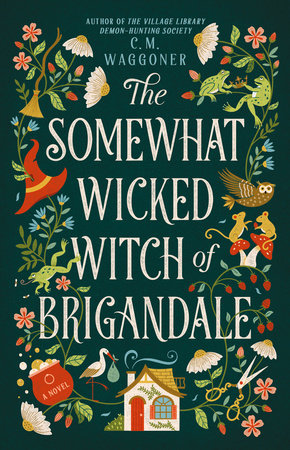
The Somewhat Wicked Witch of Brigandale

Hardcover
5.43"W x 8.3"H x 0.8"D   | 10 oz | 12 per carton
On sale Mar 17, 2026 | 224 Pages | 9798217188239

A practical witch must sabotage her beloved son's ascension to the throne in order to keep the kingdom from ruin, in this delightful cozy fantasy from the author of The Ruthless Lady’s Guide to Wizardry.

Once upon a time, a somewhat wicked witch named Gretsella lived in a cozy little cottage in the Dark Forest of Brigandale. She dispensed herbs and tinctures at reasonable prices, met with her slightly oddball coven on a regular basis, and had absolutely no need of any further company whatsoever, thank you very much. But then one afternoon, Gretsella came home to find a screaming infant on her doorstep.

Against all her better judgement, she took the baby in. She named him Bradley.

Eighteen years later, Bradley has grown into a bafflingly likable young man under Gretsella’s extremely tolerant—one might even say doting—eye. But the witch’s hopes for an unremarkable yet fulfilling life for her son are shattered when small woodland animals start prophesying that he is the lost prince and should ascend to the throne. Bradley ignores Gretsella’s advice that prophecies and talking chipmunks are to be avoided at all costs, and sets off for the capital. But soon confusion and chaos are reigning, and scheming courtiers are using Bradley for their own ends. Sometimes a witch has to roll up her sleeves and take matters into her own cauldron. So Gretsella resolves to bring about the downfall of her darling son…
© Rebecca Pusaterre
C. M. Waggoner grew up in rural upstate New York, where she spent a lot of time reading fantasy novels in a swamp. She studied creative writing at SUNY Purchase and lived in China for eight years before moving to Albany, New York, where she now lives with her husband and daughter. She is the author of three books: Unnatural Magic, The Ruthless Lady’s Guide to Wizardry, and The Village Library Demon-Hunting Society. When she’s not writing or reading, she enjoys cooking, trying to learn how to draw, and going on extremely long walks. To voice your complaints to the management (or sign up for her mailing list), visit cmwaggoner.com. View titles by C. M. Waggoner
Available for sale exclusive:
•     Afghanistan
•     Aland Islands
•     Albania
•     Algeria
•     Andorra
•     Angola
•     Anguilla
•     Antarctica
•     Antigua/Barbuda
•     Argentina
•     Armenia
•     Aruba
•     Australia
•     Austria
•     Azerbaijan
•     Bahamas
•     Bahrain
•     Bangladesh
•     Barbados
•     Belarus
•     Belgium
•     Belize
•     Benin
•     Bermuda
•     Bhutan
•     Bolivia
•     Bonaire, Saba
•     Bosnia Herzeg.
•     Botswana
•     Bouvet Island
•     Brazil
•     Brit.Ind.Oc.Ter
•     Brit.Virgin Is.
•     Brunei
•     Bulgaria
•     Burkina Faso
•     Burundi
•     Cambodia
•     Cameroon
•     Canada
•     Cape Verde
•     Cayman Islands
•     Centr.Afr.Rep.
•     Chad
•     Chile
•     China
•     Christmas Islnd
•     Cocos Islands
•     Colombia
•     Comoro Is.
•     Congo
•     Cook Islands
•     Costa Rica
•     Croatia
•     Cuba
•     Curacao
•     Cyprus
•     Czech Republic
•     Dem. Rep. Congo
•     Denmark
•     Djibouti
•     Dominica
•     Dominican Rep.
•     Ecuador
•     Egypt
•     El Salvador
•     Equatorial Gui.
•     Eritrea
•     Estonia
•     Ethiopia
•     Falkland Islnds
•     Faroe Islands
•     Fiji
•     Finland
•     France
•     Fren.Polynesia
•     French Guinea
•     Gabon
•     Gambia
•     Georgia
•     Germany
•     Ghana
•     Gibraltar
•     Greece
•     Greenland
•     Grenada
•     Guadeloupe
•     Guam
•     Guatemala
•     Guernsey
•     Guinea Republic
•     Guinea-Bissau
•     Guyana
•     Haiti
•     Heard/McDon.Isl
•     Honduras
•     Hong Kong
•     Hungary
•     Iceland
•     India
•     Indonesia
•     Iran
•     Iraq
•     Ireland
•     Isle of Man
•     Israel
•     Italy
•     Ivory Coast
•     Jamaica
•     Japan
•     Jersey
•     Jordan
•     Kazakhstan
•     Kenya
•     Kiribati
•     Kuwait
•     Kyrgyzstan
•     Laos
•     Latvia
•     Lebanon
•     Lesotho
•     Liberia
•     Libya
•     Liechtenstein
•     Lithuania
•     Luxembourg
•     Macau
•     Macedonia
•     Madagascar
•     Malawi
•     Malaysia
•     Maldives
•     Mali
•     Malta
•     Marshall island
•     Martinique
•     Mauritania
•     Mauritius
•     Mayotte
•     Mexico
•     Micronesia
•     Minor Outl.Ins.
•     Moldavia
•     Monaco
•     Mongolia
•     Montenegro
•     Montserrat
•     Morocco
•     Mozambique
•     Myanmar
•     Namibia
•     Nauru
•     Nepal
•     Netherlands
•     New Caledonia
•     New Zealand
•     Nicaragua
•     Niger
•     Nigeria
•     Niue
•     Norfolk Island
•     North Korea
•     North Mariana
•     Norway
•     Oman
•     Pakistan
•     Palau
•     Palestinian Ter
•     Panama
•     PapuaNewGuinea
•     Paraguay
•     Peru
•     Philippines
•     Pitcairn Islnds
•     Poland
•     Portugal
•     Puerto Rico
•     Qatar
•     Reunion Island
•     Romania
•     Russian Fed.
•     Rwanda
•     S. Sandwich Ins
•     Saint Martin
•     Samoa,American
•     San Marino
•     SaoTome Princip
•     Saudi Arabia
•     Senegal
•     Serbia
•     Seychelles
•     Sierra Leone
•     Singapore
•     Sint Maarten
•     Slovakia
•     Slovenia
•     Solomon Islands
•     Somalia
•     South Africa
•     South Korea
•     South Sudan
•     Spain
•     Sri Lanka
•     St Barthelemy
•     St. Helena
•     St. Lucia
•     St. Vincent
•     St.Chr.,Nevis
•     St.Pier,Miquel.
•     Sth Terr. Franc
•     Sudan
•     Suriname
•     Svalbard
•     Swaziland
•     Sweden
•     Switzerland
•     Syria
•     Tadschikistan
•     Taiwan
•     Tanzania
•     Thailand
•     Timor-Leste
•     Togo
•     Tokelau Islands
•     Tonga
•     Trinidad,Tobago
•     Tunisia
•     Turkey
•     Turkmenistan
•     Turks&Caicos Is
•     Tuvalu
•     US Virgin Is.
•     USA
•     Uganda
•     Ukraine
•     Unit.Arab Emir.
•     United Kingdom
•     Uruguay
•     Uzbekistan
•     Vanuatu
•     Vatican City
•     Venezuela
•     Vietnam
•     Wallis,Futuna
•     West Saharan
•     Western Samoa
•     Yemen
•     Zambia
•     Zimbabwe

Chapter 1

In Which Gretsella Receives
an Unusual Delivery

Once upon a time, on a somewhat muggy Wednesday afternoon in late August, the witch Gretsella arrived home to her cottage in the Dark Forest of Brigandale in the Kingdom of Evermore to find a bottle of milk on her steps. There was also a screaming baby.

The milk was there because the milkman always came on Wednesdays. Gretsella paid him to do so. She didn't know when or why a babyman had come as well, though it seemed clear that when the babyman cameth, he had cometh for her. Attached to the baby's ankle was a luggage tag that read "To be taken into the care of Gretsella, the Witch of Brigandale with the Reasonable Prices." This was, in fact, Gretsella's preferred epithet. When it came to making a career out of witchery in today's economy, whether you were a good witch or a bad witch was of less concern than whether you were a witch whose subtle arts were accessible to the middle-class homemaker.

The baby was still screaming.

"Stop that," Gretsella said.

The baby did.

"Well, at least you know your manners," Gretsella said, and carried the baby inside.

Gretsella's cottage was a nice, cozy little place, if Gretsella said so herself, which Gretsella often did. Gretsella was firmly convinced that her home could not be surpassed by the finest mansions in all of Evermore. On this point, she might not have been entirely incorrect. It was a cottage perfectly positioned and enchanted to catch only the coolest, most fragrant breezes in summer, and in winter it was always snug and warm and smelled of the rosemary tincture that Gretsella used for everything from washing her hair to mixing up a fortifying drink with a modest slug of gin. There were always fresh sweet rushes on the floor, and the hearth was swept as clean as the dinner plates. It was, in short, a very wholesome atmosphere for a baby to visit, if a baby saw fit to go visiting. Gretsella could think of no reason why the baby shouldn't be invited inside.

Though she had never had any children of her own, Gretsella had never found herself particularly intimidated by babies. As she saw it, they were a bit like wolves and termites and fast-growing asymmetrical moles: One only needed to be firm with them. That was, at least, her own experience. She'd noticed that people who had the misfortune not to be witches seemed to find things a bit more difficult. In any case, within half an hour or so, she had given the baby a thorough scrubbing down in a dishpan and diapered him with a clean tea towel, then set him down in a breadbasket, where he proceeded to placidly gnaw upon his own fist.

"I don't see why you're looking so satisfied with yourself," Gretsella said. "A helpless infant all alone in the world, with no way to make an honest living."

The baby had nothing to say for himself.

"And why give me a baby?" Gretsella asked him. "It isn't as if I took out an advertisement in the paper. Wanted: one able infant-of-all-work. Ridiculous! Of what possible use could you be?"

The baby made no reply.

"Ah, well, if you insist on being difficult, I suppose there isn't anything else for it," Gretsella said, and began to search the cottage for supplies to make the baby a more comfortable bed.

Over the next few days, Gretsella and the baby embarked upon their new life together, and she found herself growing fond of him. It was a bit like having a particularly useless familiar. Her last familiar had been a black cat who could smell demons. The baby mostly smelled terrible. He was lovable, though, in his own way. Gretsella had worked miracles for people who expressed less joy and enthusiasm for her efforts than the baby did whenever she pretended that a spoonful of mashed peas was an owl flying into the hollow of a tree.

She decided to name him Bradley.

Bradley was, on the whole, a very well-behaved young person. He only very rarely made a fuss in the evenings. On these occasions, Gretsella would sing him to sleep with songs of her own invention, which tended to run along broadly similar lines:

Go to sleep, little baby, and don't give me cause

To feed you to creatures with sharp shiny claws.

The forest is teeming with creatures who creep,

So quit with your crying and go straight to sleep!

This generally seemed to do the trick.


One day-after Bradley had been sleeping in one of her bureau drawers and dirtying her tea towels for almost a week-Gretsella was outside hanging some laundry on the line, with Bradley grubbing around in the grass by her feet, when she heard horses approaching.

She straightened up and glared in the direction of the sound as two armored men came riding into sight. "You there! Old woman!" one of them called out.

She glared harder. "Witch."

"You!" the soldier said.

"Yes, me," she said. "I'm a witch. Now try that again."

"Oh," the soldier said. "You there! Witch!"

"Yes?" Gretsella said politely.

The soldier took a moment to sit up taller in his saddle before he got to the point. "Have you seen any strange babies around here?"

Gretsella frowned. "Why do you ask?"

"Oh," the soldier said, with a glance at his companion, "no reason."

This didn't strike Gretsella as particularly convincing. "No," she said after a moment. "There aren't any strange babies here."

"But what about that one?" the second soldier asked, and pointed at Bradley, who was stuffing a fistful of grass into his mouth.

"He's not strange; he's Bradley," Gretsella said. "He's my baby."

The soldier looked somewhat dubious. "He doesn't look much like you."

This was, in fairness, quite true. Gretsella was very tall and very thin and very pale, with green eyes and freckles and a long, crooked nose and an unmanageable head of graying red curls. Bradley, being a mere infant, was very short and very fat. He also had a tuft of straight black hair growing out of the center of his forehead, a complexion a shade or two darker than Gretsella's own, and merry dark eyes, which were nearly swallowed up by what persons more sentimental than Gretsella might deem irresistibly chubby little cheeks. Gretsella drew herself up a bit. "Bradley," she said, "has no obligation whatsoever to look like anyone but himself."

The soldiers seemed unable to mount any objections to this argument. The first soldier cleared his throat. "And aren't you a bit long in the tooth to have a child of that age?"

Gretsella's glare intensified. "I have no obligation whatsoever to be of any age other than my own," she said. "Now go away, both of you. Shoo."

The soldiers stayed where they were. Gretsella turned her attention to their horses and gave each of them a good long look straight in the eye. Then she said, very firmly, "Go away, and don't come back."

The horses left. The soldiers, being mounted on their backs, left with them. Gretsella finished hanging out her laundry, and then she and Bradley set up a nice old-fashioned soldier-, salesman-, taxman-, and missionary-repelling perimeter around the garden. "I don't know why it's been so long since I set one of these up," Gretsella said to Bradley. "What a negligent witch Mother is! Isn't that right, Bradley?"

Bradley cooed.

A Digression on the
Subject of Witches

Once upon a time, a long time ago, a lonely little girl wandered through a dark wood. The little girl had a real name, but everybody called her Carrots. She climbed up onto a low branch in a tree-she was the sort of little girl who would climb as high as there were convenient handholds, but no higher-made herself comfortable, and thought about the universe. She didn't stumble upon any remarkable insights. She was an ordinary little girl, not a philosopher-king.

Despite this, the universe said, Hmm.

If you're the sort of person who reads, you'll be aware that fairy tales ought to be taken seriously in their essence, if not in their particularity. Fairy tales, like fairies themselves, are not overly concerned with factual accuracy. They sometimes mislead. You should, therefore, take the following explanation of a peculiar phenomenon with a grain of salt: It's a little-known fact that, in the Kingdom of Evermore, just as caterpillars turn into butterflies, lonely little girls sometimes turn into witches.

The loneliness that creates a witch can't be the temporary loneliness of a child whose parents have left her alone to fend for herself for an afternoon. It's a deeper and more abiding loneliness than that. It's the sort of loneliness felt by a little girl who, for whatever reason, walks alone into the woods and climbs up into trees to think about the universe more often than she's invited to birthday parties. It's the sort of loneliness that, over time, curdles into something that isn't loneliness at all. This was the way in which Carrots was lonely.

Carrots was eleven years old. She wasn't an orphan and didn't have a cruel stepmother, and she wasn't bullied by the other children for some distinct physical attribute. She was simply a little girl who was slightly too plain, slightly too loud, and slightly too intense in her contemplation of peculiar subjects. She wasn't a round peg being forced into a square hole. She was, in a world of round holes, a peg that at some point in the manufacturing process had been made very slightly oblong, to the degree that the cosmic carpenter assumed that he was probably just hammering wrong and set her aside to try again later. This was always a particular source of pain for Carrots. If she were bullied for being the lone child with flashing green eyes and flame-colored hair in a village of dull, ordinary-looking children, that would be one thing. She'd be able to anticipate going on an exciting hero's journey and meeting lots of people who would recognize her remarkable qualities for what they were. Carrots, unfortunately, was shunned by the other children not because they were nasty provincial little bullies but because she was the sort of child who read a lot of books, thought she understood more about the world than she actually did, and didn't understand how to play with the other children without annoying them. This made her very lonely, but she told herself that she didn't care about those dull, silly children in the village anyway.

All of this was made worse by the fact that the pain felt by a lonely little girl is taken seriously by almost nobody, including the little girl herself. She is forced, therefore, to imagine herself into a world where she is a more important and interesting person experiencing a more important and interesting kind of pain. It is this specific combination of loneliness, pain, and inward-directed imaginative power that creates the ideal alluvium for germinating the seeds of witchcraft.

This condition of proto-witchery is not, strictly speaking, limited to little girls, though they experience it more frequently than any other type of person. Just as, under the right circumstances, towering trees can be found growing inside dark caves or clinging to the sides of sheer rock faces, this type of little-girl loneliness sometimes finds its expression in an embittered young widow, a forlorn and delicate elderly man, or, in one notable case, a desperately unhappy forty-five-year-old sergeant major struggling to reacclimate to civilian life after many years of fighting overseas. It is, however, an absolute fact that unhappy little girls are the ideal existential ceramic crock for fermenting the supernatural sauerkraut that is a fully developed adult witch.

Despite this rich, dark loam of little-girl loneliness being endemic in girls between the ages of seven and seventeen, it is not sufficient for a girl to become a witch. It's generally more likely to produce an adult with a slightly above-average level of interest in stories about notorious and gruesome murders. Even in the intensely magical forest of Brigandale, all that this sort of loneliness creates is a small divot in the fabric of reality. Most lonely little girls are too busy living in reality to notice a crack in it.

That day in the tree, Carrots looked at reality, noticed a handhold in it, and pulled herself up.
The Somewhat Wicked Witch of Brigandale is wildly witty, utterly delightful, and stars a cranky crone I absolutely adore. There’s nothing somewhat about how much I love this book.” – Sangu Mandanna, New York Times bestselling author of A Witch’s Guide to Magical Innkeeping

"My favorite thing I've read all year. A fairy tale for everyone who'd rather wear sensible shoes than glass slippers... Witchy, witty, wise, and wonderful." – Julie Leong, USA Today bestselling author of The Teller of Small Fortunes

“Humorous and warmhearted... Readers seeking fun and clever comfort reading will find this hits the spot.” - Publishers Weekly

About

A practical witch must sabotage her beloved son's ascension to the throne in order to keep the kingdom from ruin, in this delightful cozy fantasy from the author of The Ruthless Lady’s Guide to Wizardry.

Once upon a time, a somewhat wicked witch named Gretsella lived in a cozy little cottage in the Dark Forest of Brigandale. She dispensed herbs and tinctures at reasonable prices, met with her slightly oddball coven on a regular basis, and had absolutely no need of any further company whatsoever, thank you very much. But then one afternoon, Gretsella came home to find a screaming infant on her doorstep.

Against all her better judgement, she took the baby in. She named him Bradley.

Eighteen years later, Bradley has grown into a bafflingly likable young man under Gretsella’s extremely tolerant—one might even say doting—eye. But the witch’s hopes for an unremarkable yet fulfilling life for her son are shattered when small woodland animals start prophesying that he is the lost prince and should ascend to the throne. Bradley ignores Gretsella’s advice that prophecies and talking chipmunks are to be avoided at all costs, and sets off for the capital. But soon confusion and chaos are reigning, and scheming courtiers are using Bradley for their own ends. Sometimes a witch has to roll up her sleeves and take matters into her own cauldron. So Gretsella resolves to bring about the downfall of her darling son…

Creators

© Rebecca Pusaterre
C. M. Waggoner grew up in rural upstate New York, where she spent a lot of time reading fantasy novels in a swamp. She studied creative writing at SUNY Purchase and lived in China for eight years before moving to Albany, New York, where she now lives with her husband and daughter. She is the author of three books: Unnatural Magic, The Ruthless Lady’s Guide to Wizardry, and The Village Library Demon-Hunting Society. When she’s not writing or reading, she enjoys cooking, trying to learn how to draw, and going on extremely long walks. To voice your complaints to the management (or sign up for her mailing list), visit cmwaggoner.com. View titles by C. M. Waggoner

Excerpt

Chapter 1

In Which Gretsella Receives
an Unusual Delivery

Once upon a time, on a somewhat muggy Wednesday afternoon in late August, the witch Gretsella arrived home to her cottage in the Dark Forest of Brigandale in the Kingdom of Evermore to find a bottle of milk on her steps. There was also a screaming baby.

The milk was there because the milkman always came on Wednesdays. Gretsella paid him to do so. She didn't know when or why a babyman had come as well, though it seemed clear that when the babyman cameth, he had cometh for her. Attached to the baby's ankle was a luggage tag that read "To be taken into the care of Gretsella, the Witch of Brigandale with the Reasonable Prices." This was, in fact, Gretsella's preferred epithet. When it came to making a career out of witchery in today's economy, whether you were a good witch or a bad witch was of less concern than whether you were a witch whose subtle arts were accessible to the middle-class homemaker.

The baby was still screaming.

"Stop that," Gretsella said.

The baby did.

"Well, at least you know your manners," Gretsella said, and carried the baby inside.

Gretsella's cottage was a nice, cozy little place, if Gretsella said so herself, which Gretsella often did. Gretsella was firmly convinced that her home could not be surpassed by the finest mansions in all of Evermore. On this point, she might not have been entirely incorrect. It was a cottage perfectly positioned and enchanted to catch only the coolest, most fragrant breezes in summer, and in winter it was always snug and warm and smelled of the rosemary tincture that Gretsella used for everything from washing her hair to mixing up a fortifying drink with a modest slug of gin. There were always fresh sweet rushes on the floor, and the hearth was swept as clean as the dinner plates. It was, in short, a very wholesome atmosphere for a baby to visit, if a baby saw fit to go visiting. Gretsella could think of no reason why the baby shouldn't be invited inside.

Though she had never had any children of her own, Gretsella had never found herself particularly intimidated by babies. As she saw it, they were a bit like wolves and termites and fast-growing asymmetrical moles: One only needed to be firm with them. That was, at least, her own experience. She'd noticed that people who had the misfortune not to be witches seemed to find things a bit more difficult. In any case, within half an hour or so, she had given the baby a thorough scrubbing down in a dishpan and diapered him with a clean tea towel, then set him down in a breadbasket, where he proceeded to placidly gnaw upon his own fist.

"I don't see why you're looking so satisfied with yourself," Gretsella said. "A helpless infant all alone in the world, with no way to make an honest living."

The baby had nothing to say for himself.

"And why give me a baby?" Gretsella asked him. "It isn't as if I took out an advertisement in the paper. Wanted: one able infant-of-all-work. Ridiculous! Of what possible use could you be?"

The baby made no reply.

"Ah, well, if you insist on being difficult, I suppose there isn't anything else for it," Gretsella said, and began to search the cottage for supplies to make the baby a more comfortable bed.

Over the next few days, Gretsella and the baby embarked upon their new life together, and she found herself growing fond of him. It was a bit like having a particularly useless familiar. Her last familiar had been a black cat who could smell demons. The baby mostly smelled terrible. He was lovable, though, in his own way. Gretsella had worked miracles for people who expressed less joy and enthusiasm for her efforts than the baby did whenever she pretended that a spoonful of mashed peas was an owl flying into the hollow of a tree.

She decided to name him Bradley.

Bradley was, on the whole, a very well-behaved young person. He only very rarely made a fuss in the evenings. On these occasions, Gretsella would sing him to sleep with songs of her own invention, which tended to run along broadly similar lines:

Go to sleep, little baby, and don't give me cause

To feed you to creatures with sharp shiny claws.

The forest is teeming with creatures who creep,

So quit with your crying and go straight to sleep!

This generally seemed to do the trick.


One day-after Bradley had been sleeping in one of her bureau drawers and dirtying her tea towels for almost a week-Gretsella was outside hanging some laundry on the line, with Bradley grubbing around in the grass by her feet, when she heard horses approaching.

She straightened up and glared in the direction of the sound as two armored men came riding into sight. "You there! Old woman!" one of them called out.

She glared harder. "Witch."

"You!" the soldier said.

"Yes, me," she said. "I'm a witch. Now try that again."

"Oh," the soldier said. "You there! Witch!"

"Yes?" Gretsella said politely.

The soldier took a moment to sit up taller in his saddle before he got to the point. "Have you seen any strange babies around here?"

Gretsella frowned. "Why do you ask?"

"Oh," the soldier said, with a glance at his companion, "no reason."

This didn't strike Gretsella as particularly convincing. "No," she said after a moment. "There aren't any strange babies here."

"But what about that one?" the second soldier asked, and pointed at Bradley, who was stuffing a fistful of grass into his mouth.

"He's not strange; he's Bradley," Gretsella said. "He's my baby."

The soldier looked somewhat dubious. "He doesn't look much like you."

This was, in fairness, quite true. Gretsella was very tall and very thin and very pale, with green eyes and freckles and a long, crooked nose and an unmanageable head of graying red curls. Bradley, being a mere infant, was very short and very fat. He also had a tuft of straight black hair growing out of the center of his forehead, a complexion a shade or two darker than Gretsella's own, and merry dark eyes, which were nearly swallowed up by what persons more sentimental than Gretsella might deem irresistibly chubby little cheeks. Gretsella drew herself up a bit. "Bradley," she said, "has no obligation whatsoever to look like anyone but himself."

The soldiers seemed unable to mount any objections to this argument. The first soldier cleared his throat. "And aren't you a bit long in the tooth to have a child of that age?"

Gretsella's glare intensified. "I have no obligation whatsoever to be of any age other than my own," she said. "Now go away, both of you. Shoo."

The soldiers stayed where they were. Gretsella turned her attention to their horses and gave each of them a good long look straight in the eye. Then she said, very firmly, "Go away, and don't come back."

The horses left. The soldiers, being mounted on their backs, left with them. Gretsella finished hanging out her laundry, and then she and Bradley set up a nice old-fashioned soldier-, salesman-, taxman-, and missionary-repelling perimeter around the garden. "I don't know why it's been so long since I set one of these up," Gretsella said to Bradley. "What a negligent witch Mother is! Isn't that right, Bradley?"

Bradley cooed.

A Digression on the
Subject of Witches

Once upon a time, a long time ago, a lonely little girl wandered through a dark wood. The little girl had a real name, but everybody called her Carrots. She climbed up onto a low branch in a tree-she was the sort of little girl who would climb as high as there were convenient handholds, but no higher-made herself comfortable, and thought about the universe. She didn't stumble upon any remarkable insights. She was an ordinary little girl, not a philosopher-king.

Despite this, the universe said, Hmm.

If you're the sort of person who reads, you'll be aware that fairy tales ought to be taken seriously in their essence, if not in their particularity. Fairy tales, like fairies themselves, are not overly concerned with factual accuracy. They sometimes mislead. You should, therefore, take the following explanation of a peculiar phenomenon with a grain of salt: It's a little-known fact that, in the Kingdom of Evermore, just as caterpillars turn into butterflies, lonely little girls sometimes turn into witches.

The loneliness that creates a witch can't be the temporary loneliness of a child whose parents have left her alone to fend for herself for an afternoon. It's a deeper and more abiding loneliness than that. It's the sort of loneliness felt by a little girl who, for whatever reason, walks alone into the woods and climbs up into trees to think about the universe more often than she's invited to birthday parties. It's the sort of loneliness that, over time, curdles into something that isn't loneliness at all. This was the way in which Carrots was lonely.

Carrots was eleven years old. She wasn't an orphan and didn't have a cruel stepmother, and she wasn't bullied by the other children for some distinct physical attribute. She was simply a little girl who was slightly too plain, slightly too loud, and slightly too intense in her contemplation of peculiar subjects. She wasn't a round peg being forced into a square hole. She was, in a world of round holes, a peg that at some point in the manufacturing process had been made very slightly oblong, to the degree that the cosmic carpenter assumed that he was probably just hammering wrong and set her aside to try again later. This was always a particular source of pain for Carrots. If she were bullied for being the lone child with flashing green eyes and flame-colored hair in a village of dull, ordinary-looking children, that would be one thing. She'd be able to anticipate going on an exciting hero's journey and meeting lots of people who would recognize her remarkable qualities for what they were. Carrots, unfortunately, was shunned by the other children not because they were nasty provincial little bullies but because she was the sort of child who read a lot of books, thought she understood more about the world than she actually did, and didn't understand how to play with the other children without annoying them. This made her very lonely, but she told herself that she didn't care about those dull, silly children in the village anyway.

All of this was made worse by the fact that the pain felt by a lonely little girl is taken seriously by almost nobody, including the little girl herself. She is forced, therefore, to imagine herself into a world where she is a more important and interesting person experiencing a more important and interesting kind of pain. It is this specific combination of loneliness, pain, and inward-directed imaginative power that creates the ideal alluvium for germinating the seeds of witchcraft.

This condition of proto-witchery is not, strictly speaking, limited to little girls, though they experience it more frequently than any other type of person. Just as, under the right circumstances, towering trees can be found growing inside dark caves or clinging to the sides of sheer rock faces, this type of little-girl loneliness sometimes finds its expression in an embittered young widow, a forlorn and delicate elderly man, or, in one notable case, a desperately unhappy forty-five-year-old sergeant major struggling to reacclimate to civilian life after many years of fighting overseas. It is, however, an absolute fact that unhappy little girls are the ideal existential ceramic crock for fermenting the supernatural sauerkraut that is a fully developed adult witch.

Despite this rich, dark loam of little-girl loneliness being endemic in girls between the ages of seven and seventeen, it is not sufficient for a girl to become a witch. It's generally more likely to produce an adult with a slightly above-average level of interest in stories about notorious and gruesome murders. Even in the intensely magical forest of Brigandale, all that this sort of loneliness creates is a small divot in the fabric of reality. Most lonely little girls are too busy living in reality to notice a crack in it.

That day in the tree, Carrots looked at reality, noticed a handhold in it, and pulled herself up.

Praise

The Somewhat Wicked Witch of Brigandale is wildly witty, utterly delightful, and stars a cranky crone I absolutely adore. There’s nothing somewhat about how much I love this book.” – Sangu Mandanna, New York Times bestselling author of A Witch’s Guide to Magical Innkeeping

"My favorite thing I've read all year. A fairy tale for everyone who'd rather wear sensible shoes than glass slippers... Witchy, witty, wise, and wonderful." – Julie Leong, USA Today bestselling author of The Teller of Small Fortunes

“Humorous and warmhearted... Readers seeking fun and clever comfort reading will find this hits the spot.” - Publishers Weekly
Penguin Random House Comics Retail