Close Modal

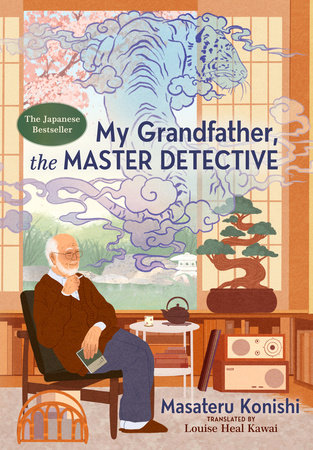
My Grandfather, the Master Detective

Look inside
Hardcover
5.47"W x 7.92"H x 1.12"D   | 12 oz | 12 per carton
On sale Mar 17, 2026 | 336 Pages | 9798217177639

A Japanese The Thursday Murder Club, taking healing fiction for a mystery-filled spin with this bestseller that has sold more than 200,000 copies in Japan.

He’s not your average Grandpa.

As a lover of classic crime stories, it’s no surprise that schoolteacher Kaede encounters everyday mysteries more often than your typical twenty-seven-year-old.

Solving them is another matter, though. For that, she turns to her beloved grandfather, who retains a keen sharpness of mind despite his dementia, and who was once a key member of The Waseda Mystery Club. From impossible locked room murders to confounding missing persons cases, the grandfather-granddaughter duo "weave stories" to get to the bottom of every mystery. But all the while, an insidious shadow from Kaede’s past slowly closes in on her . . .

Steeped in references to classic crime from Christie to Chesterton to Poe, My Grandfather, the Master Detective plays with the genre, capturing readers' imagination in this Tokyo-set escapist mystery. Its charming characters and affectionate focus on relationships echo heartwarming Japanese titles such as Before the Coffee Gets Cold.
© courtesy of the author
Masateru Konishi graduated from the Department of English and American Literature at Meiji University, and now works as a writer for TV and radio. He has previously written for the stage as well as a manga story, but My Grandfather, the Master Detective is his debut novel. Partly based on his own experience of caring for his father with dementia, the book won the twenty-first edition of the prestigious ‘This Mystery is Amazing!’ Grand Prize. View titles by Masateru Konishi
Available for sale exclusive:
•     Canada
•     Guam
•     Minor Outl.Ins.
•     North Mariana
•     Philippines
•     Puerto Rico
•     Samoa,American
•     US Virgin Is.
•     USA

Available for sale non-exclusive:
•     Afghanistan
•     Aland Islands
•     Albania
•     Algeria
•     Angola
•     Antarctica
•     Argentina
•     Armenia
•     Aruba
•     Azerbaijan
•     Bahrain
•     Belarus
•     Benin
•     Bhutan
•     Bolivia
•     Bonaire, Saba
•     Bosnia Herzeg.
•     Bouvet Island
•     Brazil
•     Burkina Faso
•     Burundi
•     Cambodia
•     Cape Verde
•     Centr.Afr.Rep.
•     Chad
•     Chile
•     China
•     Colombia
•     Comoro Is.
•     Congo
•     Cook Islands
•     Costa Rica
•     Cuba
•     Curacao
•     Dem. Rep. Congo
•     Djibouti
•     Dominican Rep.
•     Ecuador
•     Egypt
•     El Salvador
•     Equatorial Gui.
•     Eritrea
•     Ethiopia
•     Faroe Islands
•     Fren.Polynesia
•     French Guinea
•     Gabon
•     Georgia
•     Guadeloupe
•     Guatemala
•     Guinea Republic
•     Guinea-Bissau
•     Haiti
•     Heard/McDon.Isl
•     Honduras
•     Hong Kong
•     Indonesia
•     Iran
•     Iraq
•     Israel
•     Ivory Coast
•     Japan
•     Jordan
•     Kazakhstan
•     Kuwait
•     Kyrgyzstan
•     Laos
•     Lebanon
•     Liberia
•     Libya
•     Macau
•     Macedonia
•     Madagascar
•     Mali
•     Marshall island
•     Martinique
•     Mauritania
•     Mayotte
•     Mexico
•     Micronesia
•     Moldavia
•     Mongolia
•     Montenegro
•     Morocco
•     Nepal
•     New Caledonia
•     Nicaragua
•     Niger
•     Niue
•     North Korea
•     Oman
•     Palau
•     Palestinian Ter
•     Panama
•     Paraguay
•     Peru
•     Qatar
•     Reunion Island
•     Russian Fed.
•     Rwanda
•     Saint Martin
•     SaoTome Princip
•     Saudi Arabia
•     Senegal
•     Serbia
•     Sint Maarten
•     South Korea
•     South Sudan
•     St Barthelemy
•     St.Pier,Miquel.
•     Sth Terr. Franc
•     Sudan
•     Suriname
•     Svalbard
•     Syria
•     Tadschikistan
•     Taiwan
•     Thailand
•     Timor-Leste
•     Togo
•     Tunisia
•     Turkmenistan
•     Ukraine
•     Unit.Arab Emir.
•     Uruguay
•     Uzbekistan
•     Venezuela
•     Vietnam
•     Wallis,Futuna
•     West Saharan
•     Western Samoa

Not available for sale:
•     Andorra
•     Anguilla
•     Antigua/Barbuda
•     Australia
•     Austria
•     Bahamas
•     Bangladesh
•     Barbados
•     Belgium
•     Belize
•     Bermuda
•     Botswana
•     Brit.Ind.Oc.Ter
•     Brit.Virgin Is.
•     Brunei
•     Bulgaria
•     Cameroon
•     Cayman Islands
•     Christmas Islnd
•     Cocos Islands
•     Croatia
•     Cyprus
•     Czech Republic
•     Denmark
•     Dominica
•     Estonia
•     Falkland Islnds
•     Fiji
•     Finland
•     France
•     Gambia
•     Germany
•     Ghana
•     Gibraltar
•     Greece
•     Greenland
•     Grenada
•     Guernsey
•     Guyana
•     Hungary
•     Iceland
•     India
•     Ireland
•     Isle of Man
•     Italy
•     Jamaica
•     Jersey
•     Kenya
•     Kiribati
•     Latvia
•     Lesotho
•     Liechtenstein
•     Lithuania
•     Luxembourg
•     Malawi
•     Malaysia
•     Maldives
•     Malta
•     Mauritius
•     Monaco
•     Montserrat
•     Mozambique
•     Myanmar
•     Namibia
•     Nauru
•     Netherlands
•     New Zealand
•     Nigeria
•     Norfolk Island
•     Norway
•     Pakistan
•     PapuaNewGuinea
•     Pitcairn Islnds
•     Poland
•     Portugal
•     Romania
•     S. Sandwich Ins
•     San Marino
•     Seychelles
•     Sierra Leone
•     Singapore
•     Slovakia
•     Slovenia
•     Solomon Islands
•     Somalia
•     South Africa
•     Spain
•     Sri Lanka
•     St. Helena
•     St. Lucia
•     St. Vincent
•     St.Chr.,Nevis
•     Swaziland
•     Sweden
•     Switzerland
•     Tanzania
•     Tokelau Islands
•     Tonga
•     Trinidad,Tobago
•     Turkey
•     Turks&Caicos Is
•     Tuvalu
•     Uganda
•     United Kingdom
•     Vanuatu
•     Vatican City
•     Yemen
•     Zambia
•     Zimbabwe

CAUTION: This email originated from outside of Penguin Random House. Please be extra cautious when opening file attachments or clicking on links.

Chapter 1

Those Little Scarlet Cells

1

"A blue tiger dropped by this morning," said Kaede's grandfather. "I wonder how it managed to turn the knob. Must be amazingly adept with its paws."

The fact that a tiger had been in his study, or even that its fur was blue, seemed far less puzzling to him than how it had managed to open the front door.

"Good thing you didn't get bitten," Kaede remarked, careful to sound casual about it, but in truth her heart sank a little.

Here we go again . . .

Kaede managed to make it out here to the Himonya district of Tokyo only once a week, and when she did, she generally found her grandfather asleep. But then, in the rare moments she caught him awake, all he'd talk about were his hallucinations, and she'd leave without having had any kind of meaningful conversation at all.

Nevertheless, she listened without complaint to his tale of the blue tiger, nodding along at the appropriate moments. She cherished the time she got to spend with her grandfather in the house she'd grown up in.

"And when the tiger went to leave . . ." Grandfather said, imitating the way it crossed its forelegs in front as it walked, "it flashed me a big smile."

"The tiger smiled?"

And now here I go again, too . . .

Yet another far-fetched tale, and she found herself hanging on his every word. At first she just pretended to listen, but her grandfather was such a skilled storyteller that she was completely drawn in to his alternate universe. And now he'd even gotten her believing that at any moment a blue tiger might leap out of one of the illustrated books on the shelf.


It seemed Grandfather had had his fill of talking. His eyelids began to close.

Kaede's grandfather spent all day in this room in his reclining chair. She had gone to the trouble of finding an extra-large one to suit his tall, skinny frame, but this had turned out to be a mistake, as now he was so comfortable he didn't budge from his spot.

A wooden walking stick, which he needed to get around, was propped up against the side table. The care manager who'd recommended it would complain that although he'd use it to go to the toilet, he never bothered with it whenever he was browsing his bookshelves. "One of these days he's going to have a fall," she'd say and sigh reproachfully.

Still reading books, then, but how much is he really taking in?

The crammed bookshelves gave off a musty smell of old ink. Kaede was reminded of her beloved Jinbōchō, the used-bookshop district in Tokyo.

As Kaede's grandfather dozed in his chair, she observed him under the dappled sunlight from the window. The high bridge of his nose and deep crow's feet created shadows on a face that was surprisingly blemish-free for a seventy-one-year-old. These days his cheeks had hollowed out, but this served to accentuate his chiseled features. His long, thick hair, parted in the middle above his prominent forehead, was about seventy percent white these days. The salt-and-pepper effect reminded Kaede of a Roman emperor's head engraved on a coin.

As his granddaughter, Kaede was biased, but she knew he was an impressive-looking man.

He must have been popular with the ladies . . .

She retrieved the blanket that had slipped down and gently covered him back up.

After she finished cleaning her grandfather's room, she sprayed the space with an antibacterial solution that had the fragrance of soap, careful not to let it come into contact with any of the books. It was about time for the physiotherapist's visit.

This antibacterial spray wasn't only for cleaning purposes; her grandfather would often hallucinate that the room was filled with tiny insects, such as mosquitoes. At those times the spray doubled as a makeshift "insecticide."

All right, then, Grandpa. I'll see you soon . . .

Over by the door was a dressing table with a mirror that had belonged to Kaede's grandmother. Rather than thinking of it as having aged, Kaede preferred to think of it as having evolved through the years, its wood grain accumulating layers of time, giving it a complex depth of color. She took a hairbrush from the drawer of the dresser and quickly fixed her hair, stopping to compose her facial expression in the mirror.

Smile!

The solid oak door to the study had been replaced with sliding doors, in anticipation of the day her grandfather would be confined to a wheelchair. Kaede silently slid the door shut behind her and left the house.

2

Aboard a swaying Toyoko Line train, Kaede caught sight of her face in the window. It was expressionless. There was no hint of the carefully composed smile she'd worn for her visit.

Twilight had fallen and the sky was streaked with faint pink lines like the traces of a lipstick kiss. It was early autumn and the cumulonimbus clouds of summer were gone; instead, the sky was filled with clouds of all different shapes. Memories of her grandfather flitted through Kaede's mind.

Twenty-three years earlier, when Kaede had been four, she sat with him on the low wooden engawa veranda as they watched the reddening sky. Grandfather's bright and wise eyes had dropped to his beloved granddaughter, secure in his lap.

"Kaede? See those clouds over there-what do you think they look like? See if you can make up a story using all three."

In retrospect, she realized he was asking for a classic three-topic rakugo story. He'd been trying to give flight to her imagination. It was typical of her grandfather and his knack for nurturing creativity.

Kaede hadn't hesitated.

"That cloud there is a tiny little grandpa. That cloud is a squished grandpa. And then the biggest cloud of all is a big, fat grandpa, bigger than you."

Grandfather's face broke into a huge grin.

"Well, we can't make a story out of that . . . or can we?"

And then, to Kaede's surprise and delight, he made up a fairy tale for her on the spot, titled "The Three Grandpas." She didn't recall all the details, but she did remember the ending, where the greedy big fat grandpa ate up all the cold medicine in the world, mistaking it for sugar, and although everyone teased him for it, he ended up living the longest life of all of them.

She guessed now that the story was meant as a lesson for her four-year-old self, who had hated the bitter taste of powdered medicine. But at the time, the way he told the tale was so entertaining that she had clapped her hands in delight.

"Oh, wow. Kaede, look!"

When she had looked up at the sky again, only the big fat grandpa cloud remained; the tiny little grandpa and the squished grandpa had, quite literally, vanished into thin air.

Just like the end of the story.

Kaede had stared in amazement at the big fat grandpa cloud, and then her own grandfather's face.

Thinking back, she realized that he must have been keeping an eye on the cloud movement as he spun his tale. Had either the tiny little grandpa or the squished grandpa survived, then for sure the story would have taken quite a different turn.

"Hey, Grandpa! Tell me another story, or else . . ."

She'd reached up and tugged on the hair growing from the mole on his Adam's apple.

Kaede recalled how easily the hair had come out, which at the time made her burst into giggles.

Maybe it was my fault . . . Did I pull the plug and drain Grandpa's mind?


It was only six months ago that Grandfather had started showing symptoms.

They'd gone for a walk together and Kaede noticed his stride had gotten shorter.

"Grandpa, are you putting on weight or something? Your feet can't seem to keep up with you."

"Must be getting old," he'd replied with a self-deprecating smile.

At first Kaede put it down to weight gain or, as he said, a simple case of aging. At least that was what she wanted to believe.

However, the decline was fast. His hand shook when he drank his coffee, and whenever Kaede visited, she found him dozing in his study chair. His posture grew more hunched and his movements sluggish.

But then came the biggest shock of all. Kaede would never forget the day.

Late one night her phone rang. She rubbed her eyes and picked it up.

"Um . . . I'm with emergency medical services . . ."

The young man at the other end of the line seemed to be having trouble expressing what he wanted to say.

"Am I speaking to Kaede-san? Good. I see. We found your name on a note pinned to the wall . . . as an emergency contact. It seems that your grandfather called for an ambulance. And then . . . well, how can I put it . . . ?"

"What's happened?"

"He's saying that you're here, um . . . lying dead in a pool of blood."

At his regular clinic, they said that it might be Parkinson's disease, but they couldn't be sure, and they recommended that he go to a major hospital. At the university hospital they did a full battery of tests, including a CT scan.

The young female doctor gave Kaede the diagnosis, despite the presence of her grandfather asleep in the seat next to her.

"Your grandfather has Lewy body dementia."


It had been a struggle for Kaede to accept that her brilliant grandfather had been diagnosed with dementia at such an early age; he was only just into his seventies. However, after researching, she found that every one of his symptoms was consistent with the disease. She read that more than four and a half million people in Japan suffered from dementia, and that it wasn’t one single condition; there were several different variations of the disease.

Dementia can be categorized into three main types.

Most commonly, there's Alzheimer's, accounting for about seventy percent of cases. It's caused by the accumulation of plaques on the brain. These plaques is created by the breakdown of a protein known as beta-amyloid 42. When people hear the word dementia, it's likely Alzheimer's that comes to mind first.

The second most common is vascular dementia, which is brought on by the aftereffects of a stroke, and is the cause of twenty percent of dementia cases.

Both of these types present with similar symptoms: memory loss that causes the patient to repeat the same thing over and over, and disorientation, where sense of time and/or place becomes hazy and the patient often ends up wandering around, confused.

And then there's dementia with Lewy bodies (DLB), commonly known as Lewy body dementia, affecting ten percent of the patient total.

This was Kaede's grandfather's diagnosis.

DLB wasn't officially named until 1995, making it one of the more recently discovered diseases in the long history of human illness. It has gained attention in recent years as "the third dementia," with the race to understand its pathology underway in the medical field. There are a number of ongoing clinical trials.

Tiny, fried-egg-shaped crimson structures called Lewy bodies are consistently found on the brains and brainstems of DLB patients. These mini fried eggs cause symptoms such as tremors in the limbs and walking difficulties, often referred to as Parkinson's symptoms, or shouting out in one's sleep, known as REM sleep behavior disorder. They also lead to states of drowsiness during the day, known as hypersomnia, and to spatial recognition impairment, where patients cannot perceive distances accurately.

However, the most distinctive symptom, and one that is unique to this variant of dementia, is the visual hallucinations. While the appearance of the hallucinations varies-some patients report seeing them in black and white, others in color-the common denominator is that they are always described as "vivid," "graphic," or "distinct."

For example, upon waking in the morning and opening their eyes, a patient may see ten people standing in their room, silently staring at them. Or perhaps there's a giant snake coiled up on the dining table. Or sometimes a girl with pigtails will trail behind them all day long.

Fantastical visions are not uncommon, either.

A pig marches briskly across the room on two legs.

A fairy leaps gracefully onto a plate.

And then of course there's the blue tiger that Kaede's grandfather claimed to see . . .

Oddly, in most cases, there's no accompanying auditory hallucination. These creatures that manifest themselves are purely visual illusions. In other words, they don't talk to the patient.

Human beings possess five senses, but it is believed that ninety percent of the information we receive from the world around us is through sight. To the majority of DLB sufferers, these hallucinations are completely real. The most common expression used by patients is "seeing is believing." It's no easy task to convince them that something doesn't exist when they can see it with their own eyes.

When their friends or family use phrases such as "there's nothing there" or "that's impossible" or even "pull yourself together," it's very common for the patient to get angry. This is one of the reasons why caring for DLB patients is so difficult.

In a handbook for caregivers, Kaede found the following advice:

"If the patient tells you for example that they can see a giant insect or that they're scared, don't dismiss their fears with responses such as "It's just your imagination" or "You know it's because of your illness." Be patient with them. Try clapping your hands and saying, "Look! I scared it away. You'll be fine now." Changing the topic of conversation is also effective."

That all made sense, Kaede thought.

Her grandfather had never in his life raised his voice to her, and she was determined not to get into an argument with him. For that reason, she always avoided discussing his illness with him. And when he talked about his hallucinations, she was careful not to deny their existence.

Making a patient aware that they have dementia is next to impossible. Even if it were possible, it would be too cruel.

But at the same time, Kaede couldn't help but feel an odd sense of unease. It was like doing a simple mathematical equation that should have divided evenly, but inexplicably left a remainder where there shouldn't be one . . . It was a feeling subtly different from the wishful thinking that her grandfather's dementia wouldn't develop further or that he would never lose his sharp mind.

But something's not quite right . . .

What was causing her feeling of unease? Kaede couldn't identify it.
A Beyond the Bookends Most Anticipated Mystery of March
An Our Novel World Best New Crime Thriller

Before the Coffee Gets Cold meets Agatha Christie. Neither age nor a diagnosis of Lewy body dementia (LBD) can keep Grandfather from solving difficult cases. He’s as clever as Hercule Poirot and as observant as Miss Marple, a gentle, brilliant, and dynamic sleuth you won’t soon forget.” —Ellery Adams, New York Times bestselling author of The Secret, Book & Scone Society

"Heartfelt and clever, My Grandfather, the Master Detective expertly weaves together ideas of family and loss alongside homage to classic detective fiction spanning eras and countries. …An utterly delightful ode to the power of storytelling in understanding the curve balls life throws at you.” —Kristen Perrin, New York Times bestselling author of How to Solve Your Own Murder

“[A] rich emotional landscape. . . Will appeal to fans of Richard Osman’s The Thursday Murder Club, Hisashi Kashiwai’s The Kamogawa Food Detectives, and Susan Fletcher's The Night in Question.” —Booklist (starred)

“[A] gentle, puzzle-focused crime novel in the vein of classic detective fiction . . . The beauty lies in ordinary, complicated people figuring out how to live as much as how to solve crimes.” —Crime Fiction Lover

“Brain-teasing mysteries presented in something like a fairytale framework.” —Kirkus

“Konishi strikes a balance between the cozy mystery genre and the Japanese (and Korean) comfort novels in translation that are having a moment on the bestsellers’ lists . . . Much of the sense of calmness, control and, well, comfort, is down to the English translation by Louise Heal Kawai, who puts the reader at ease with her fluid translation.” —Asian Review of Books

“Masateru Konishi has infused the fun and page-turning intrigue of a first-rate mystery story with profound filial love, respect, and compassion. A rare and multi-faceted mystery, My Grandfather, the Master Detective transcends genre. It’s guaranteed to delight and deeply affect fans of detective stories, readers seeking to explore the human condition, and everyone whose lives have been turned upside-down by this debilitating disease.” —Binnie Kirshenbaum, author of Counting Backwards

“Even when struggling with dementia, Grandfather is one hell of an armchair detective during his better, lucid moments . . . a warm recommendation and hopefully Louise Heal Kawai gets to translate the second and last book in the series. Fingers crossed!” —Beneath the Stains of Time

“[F]ans will undoubtedly happily devour this latest enjoyable entry.” —Murder, Mayhem, and Long Dogs

“Inspired with the aid of using traditional crime fiction, Konishi’s escapist tale combines warmth, sharp plotting, and affectionate person studies, making it ideal for fanatics.” —Our Novel World

About

A Japanese The Thursday Murder Club, taking healing fiction for a mystery-filled spin with this bestseller that has sold more than 200,000 copies in Japan.

He’s not your average Grandpa.

As a lover of classic crime stories, it’s no surprise that schoolteacher Kaede encounters everyday mysteries more often than your typical twenty-seven-year-old.

Solving them is another matter, though. For that, she turns to her beloved grandfather, who retains a keen sharpness of mind despite his dementia, and who was once a key member of The Waseda Mystery Club. From impossible locked room murders to confounding missing persons cases, the grandfather-granddaughter duo "weave stories" to get to the bottom of every mystery. But all the while, an insidious shadow from Kaede’s past slowly closes in on her . . .

Steeped in references to classic crime from Christie to Chesterton to Poe, My Grandfather, the Master Detective plays with the genre, capturing readers' imagination in this Tokyo-set escapist mystery. Its charming characters and affectionate focus on relationships echo heartwarming Japanese titles such as Before the Coffee Gets Cold.

Creators

© courtesy of the author
Masateru Konishi graduated from the Department of English and American Literature at Meiji University, and now works as a writer for TV and radio. He has previously written for the stage as well as a manga story, but My Grandfather, the Master Detective is his debut novel. Partly based on his own experience of caring for his father with dementia, the book won the twenty-first edition of the prestigious ‘This Mystery is Amazing!’ Grand Prize. View titles by Masateru Konishi

Excerpt

CAUTION: This email originated from outside of Penguin Random House. Please be extra cautious when opening file attachments or clicking on links.

Chapter 1

Those Little Scarlet Cells

1

"A blue tiger dropped by this morning," said Kaede's grandfather. "I wonder how it managed to turn the knob. Must be amazingly adept with its paws."

The fact that a tiger had been in his study, or even that its fur was blue, seemed far less puzzling to him than how it had managed to open the front door.

"Good thing you didn't get bitten," Kaede remarked, careful to sound casual about it, but in truth her heart sank a little.

Here we go again . . .

Kaede managed to make it out here to the Himonya district of Tokyo only once a week, and when she did, she generally found her grandfather asleep. But then, in the rare moments she caught him awake, all he'd talk about were his hallucinations, and she'd leave without having had any kind of meaningful conversation at all.

Nevertheless, she listened without complaint to his tale of the blue tiger, nodding along at the appropriate moments. She cherished the time she got to spend with her grandfather in the house she'd grown up in.

"And when the tiger went to leave . . ." Grandfather said, imitating the way it crossed its forelegs in front as it walked, "it flashed me a big smile."

"The tiger smiled?"

And now here I go again, too . . .

Yet another far-fetched tale, and she found herself hanging on his every word. At first she just pretended to listen, but her grandfather was such a skilled storyteller that she was completely drawn in to his alternate universe. And now he'd even gotten her believing that at any moment a blue tiger might leap out of one of the illustrated books on the shelf.


It seemed Grandfather had had his fill of talking. His eyelids began to close.

Kaede's grandfather spent all day in this room in his reclining chair. She had gone to the trouble of finding an extra-large one to suit his tall, skinny frame, but this had turned out to be a mistake, as now he was so comfortable he didn't budge from his spot.

A wooden walking stick, which he needed to get around, was propped up against the side table. The care manager who'd recommended it would complain that although he'd use it to go to the toilet, he never bothered with it whenever he was browsing his bookshelves. "One of these days he's going to have a fall," she'd say and sigh reproachfully.

Still reading books, then, but how much is he really taking in?

The crammed bookshelves gave off a musty smell of old ink. Kaede was reminded of her beloved Jinbōchō, the used-bookshop district in Tokyo.

As Kaede's grandfather dozed in his chair, she observed him under the dappled sunlight from the window. The high bridge of his nose and deep crow's feet created shadows on a face that was surprisingly blemish-free for a seventy-one-year-old. These days his cheeks had hollowed out, but this served to accentuate his chiseled features. His long, thick hair, parted in the middle above his prominent forehead, was about seventy percent white these days. The salt-and-pepper effect reminded Kaede of a Roman emperor's head engraved on a coin.

As his granddaughter, Kaede was biased, but she knew he was an impressive-looking man.

He must have been popular with the ladies . . .

She retrieved the blanket that had slipped down and gently covered him back up.

After she finished cleaning her grandfather's room, she sprayed the space with an antibacterial solution that had the fragrance of soap, careful not to let it come into contact with any of the books. It was about time for the physiotherapist's visit.

This antibacterial spray wasn't only for cleaning purposes; her grandfather would often hallucinate that the room was filled with tiny insects, such as mosquitoes. At those times the spray doubled as a makeshift "insecticide."

All right, then, Grandpa. I'll see you soon . . .

Over by the door was a dressing table with a mirror that had belonged to Kaede's grandmother. Rather than thinking of it as having aged, Kaede preferred to think of it as having evolved through the years, its wood grain accumulating layers of time, giving it a complex depth of color. She took a hairbrush from the drawer of the dresser and quickly fixed her hair, stopping to compose her facial expression in the mirror.

Smile!

The solid oak door to the study had been replaced with sliding doors, in anticipation of the day her grandfather would be confined to a wheelchair. Kaede silently slid the door shut behind her and left the house.

2

Aboard a swaying Toyoko Line train, Kaede caught sight of her face in the window. It was expressionless. There was no hint of the carefully composed smile she'd worn for her visit.

Twilight had fallen and the sky was streaked with faint pink lines like the traces of a lipstick kiss. It was early autumn and the cumulonimbus clouds of summer were gone; instead, the sky was filled with clouds of all different shapes. Memories of her grandfather flitted through Kaede's mind.

Twenty-three years earlier, when Kaede had been four, she sat with him on the low wooden engawa veranda as they watched the reddening sky. Grandfather's bright and wise eyes had dropped to his beloved granddaughter, secure in his lap.

"Kaede? See those clouds over there-what do you think they look like? See if you can make up a story using all three."

In retrospect, she realized he was asking for a classic three-topic rakugo story. He'd been trying to give flight to her imagination. It was typical of her grandfather and his knack for nurturing creativity.

Kaede hadn't hesitated.

"That cloud there is a tiny little grandpa. That cloud is a squished grandpa. And then the biggest cloud of all is a big, fat grandpa, bigger than you."

Grandfather's face broke into a huge grin.

"Well, we can't make a story out of that . . . or can we?"

And then, to Kaede's surprise and delight, he made up a fairy tale for her on the spot, titled "The Three Grandpas." She didn't recall all the details, but she did remember the ending, where the greedy big fat grandpa ate up all the cold medicine in the world, mistaking it for sugar, and although everyone teased him for it, he ended up living the longest life of all of them.

She guessed now that the story was meant as a lesson for her four-year-old self, who had hated the bitter taste of powdered medicine. But at the time, the way he told the tale was so entertaining that she had clapped her hands in delight.

"Oh, wow. Kaede, look!"

When she had looked up at the sky again, only the big fat grandpa cloud remained; the tiny little grandpa and the squished grandpa had, quite literally, vanished into thin air.

Just like the end of the story.

Kaede had stared in amazement at the big fat grandpa cloud, and then her own grandfather's face.

Thinking back, she realized that he must have been keeping an eye on the cloud movement as he spun his tale. Had either the tiny little grandpa or the squished grandpa survived, then for sure the story would have taken quite a different turn.

"Hey, Grandpa! Tell me another story, or else . . ."

She'd reached up and tugged on the hair growing from the mole on his Adam's apple.

Kaede recalled how easily the hair had come out, which at the time made her burst into giggles.

Maybe it was my fault . . . Did I pull the plug and drain Grandpa's mind?


It was only six months ago that Grandfather had started showing symptoms.

They'd gone for a walk together and Kaede noticed his stride had gotten shorter.

"Grandpa, are you putting on weight or something? Your feet can't seem to keep up with you."

"Must be getting old," he'd replied with a self-deprecating smile.

At first Kaede put it down to weight gain or, as he said, a simple case of aging. At least that was what she wanted to believe.

However, the decline was fast. His hand shook when he drank his coffee, and whenever Kaede visited, she found him dozing in his study chair. His posture grew more hunched and his movements sluggish.

But then came the biggest shock of all. Kaede would never forget the day.

Late one night her phone rang. She rubbed her eyes and picked it up.

"Um . . . I'm with emergency medical services . . ."

The young man at the other end of the line seemed to be having trouble expressing what he wanted to say.

"Am I speaking to Kaede-san? Good. I see. We found your name on a note pinned to the wall . . . as an emergency contact. It seems that your grandfather called for an ambulance. And then . . . well, how can I put it . . . ?"

"What's happened?"

"He's saying that you're here, um . . . lying dead in a pool of blood."

At his regular clinic, they said that it might be Parkinson's disease, but they couldn't be sure, and they recommended that he go to a major hospital. At the university hospital they did a full battery of tests, including a CT scan.

The young female doctor gave Kaede the diagnosis, despite the presence of her grandfather asleep in the seat next to her.

"Your grandfather has Lewy body dementia."


It had been a struggle for Kaede to accept that her brilliant grandfather had been diagnosed with dementia at such an early age; he was only just into his seventies. However, after researching, she found that every one of his symptoms was consistent with the disease. She read that more than four and a half million people in Japan suffered from dementia, and that it wasn’t one single condition; there were several different variations of the disease.

Dementia can be categorized into three main types.

Most commonly, there's Alzheimer's, accounting for about seventy percent of cases. It's caused by the accumulation of plaques on the brain. These plaques is created by the breakdown of a protein known as beta-amyloid 42. When people hear the word dementia, it's likely Alzheimer's that comes to mind first.

The second most common is vascular dementia, which is brought on by the aftereffects of a stroke, and is the cause of twenty percent of dementia cases.

Both of these types present with similar symptoms: memory loss that causes the patient to repeat the same thing over and over, and disorientation, where sense of time and/or place becomes hazy and the patient often ends up wandering around, confused.

And then there's dementia with Lewy bodies (DLB), commonly known as Lewy body dementia, affecting ten percent of the patient total.

This was Kaede's grandfather's diagnosis.

DLB wasn't officially named until 1995, making it one of the more recently discovered diseases in the long history of human illness. It has gained attention in recent years as "the third dementia," with the race to understand its pathology underway in the medical field. There are a number of ongoing clinical trials.

Tiny, fried-egg-shaped crimson structures called Lewy bodies are consistently found on the brains and brainstems of DLB patients. These mini fried eggs cause symptoms such as tremors in the limbs and walking difficulties, often referred to as Parkinson's symptoms, or shouting out in one's sleep, known as REM sleep behavior disorder. They also lead to states of drowsiness during the day, known as hypersomnia, and to spatial recognition impairment, where patients cannot perceive distances accurately.

However, the most distinctive symptom, and one that is unique to this variant of dementia, is the visual hallucinations. While the appearance of the hallucinations varies-some patients report seeing them in black and white, others in color-the common denominator is that they are always described as "vivid," "graphic," or "distinct."

For example, upon waking in the morning and opening their eyes, a patient may see ten people standing in their room, silently staring at them. Or perhaps there's a giant snake coiled up on the dining table. Or sometimes a girl with pigtails will trail behind them all day long.

Fantastical visions are not uncommon, either.

A pig marches briskly across the room on two legs.

A fairy leaps gracefully onto a plate.

And then of course there's the blue tiger that Kaede's grandfather claimed to see . . .

Oddly, in most cases, there's no accompanying auditory hallucination. These creatures that manifest themselves are purely visual illusions. In other words, they don't talk to the patient.

Human beings possess five senses, but it is believed that ninety percent of the information we receive from the world around us is through sight. To the majority of DLB sufferers, these hallucinations are completely real. The most common expression used by patients is "seeing is believing." It's no easy task to convince them that something doesn't exist when they can see it with their own eyes.

When their friends or family use phrases such as "there's nothing there" or "that's impossible" or even "pull yourself together," it's very common for the patient to get angry. This is one of the reasons why caring for DLB patients is so difficult.

In a handbook for caregivers, Kaede found the following advice:

"If the patient tells you for example that they can see a giant insect or that they're scared, don't dismiss their fears with responses such as "It's just your imagination" or "You know it's because of your illness." Be patient with them. Try clapping your hands and saying, "Look! I scared it away. You'll be fine now." Changing the topic of conversation is also effective."

That all made sense, Kaede thought.

Her grandfather had never in his life raised his voice to her, and she was determined not to get into an argument with him. For that reason, she always avoided discussing his illness with him. And when he talked about his hallucinations, she was careful not to deny their existence.

Making a patient aware that they have dementia is next to impossible. Even if it were possible, it would be too cruel.

But at the same time, Kaede couldn't help but feel an odd sense of unease. It was like doing a simple mathematical equation that should have divided evenly, but inexplicably left a remainder where there shouldn't be one . . . It was a feeling subtly different from the wishful thinking that her grandfather's dementia wouldn't develop further or that he would never lose his sharp mind.

But something's not quite right . . .

What was causing her feeling of unease? Kaede couldn't identify it.

Praise

A Beyond the Bookends Most Anticipated Mystery of March
An Our Novel World Best New Crime Thriller

Before the Coffee Gets Cold meets Agatha Christie. Neither age nor a diagnosis of Lewy body dementia (LBD) can keep Grandfather from solving difficult cases. He’s as clever as Hercule Poirot and as observant as Miss Marple, a gentle, brilliant, and dynamic sleuth you won’t soon forget.” —Ellery Adams, New York Times bestselling author of The Secret, Book & Scone Society

"Heartfelt and clever, My Grandfather, the Master Detective expertly weaves together ideas of family and loss alongside homage to classic detective fiction spanning eras and countries. …An utterly delightful ode to the power of storytelling in understanding the curve balls life throws at you.” —Kristen Perrin, New York Times bestselling author of How to Solve Your Own Murder

“[A] rich emotional landscape. . . Will appeal to fans of Richard Osman’s The Thursday Murder Club, Hisashi Kashiwai’s The Kamogawa Food Detectives, and Susan Fletcher's The Night in Question.” —Booklist (starred)

“[A] gentle, puzzle-focused crime novel in the vein of classic detective fiction . . . The beauty lies in ordinary, complicated people figuring out how to live as much as how to solve crimes.” —Crime Fiction Lover

“Brain-teasing mysteries presented in something like a fairytale framework.” —Kirkus

“Konishi strikes a balance between the cozy mystery genre and the Japanese (and Korean) comfort novels in translation that are having a moment on the bestsellers’ lists . . . Much of the sense of calmness, control and, well, comfort, is down to the English translation by Louise Heal Kawai, who puts the reader at ease with her fluid translation.” —Asian Review of Books

“Masateru Konishi has infused the fun and page-turning intrigue of a first-rate mystery story with profound filial love, respect, and compassion. A rare and multi-faceted mystery, My Grandfather, the Master Detective transcends genre. It’s guaranteed to delight and deeply affect fans of detective stories, readers seeking to explore the human condition, and everyone whose lives have been turned upside-down by this debilitating disease.” —Binnie Kirshenbaum, author of Counting Backwards

“Even when struggling with dementia, Grandfather is one hell of an armchair detective during his better, lucid moments . . . a warm recommendation and hopefully Louise Heal Kawai gets to translate the second and last book in the series. Fingers crossed!” —Beneath the Stains of Time

“[F]ans will undoubtedly happily devour this latest enjoyable entry.” —Murder, Mayhem, and Long Dogs

“Inspired with the aid of using traditional crime fiction, Konishi’s escapist tale combines warmth, sharp plotting, and affectionate person studies, making it ideal for fanatics.” —Our Novel World
Penguin Random House Comics Retail