Close Modal

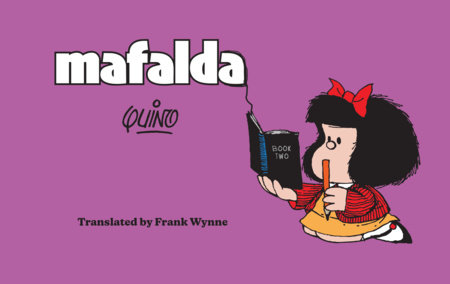
Mafalda

Book Two

Author Quino
Translated by Frank Wynne
Hardcover
9-3/4"W x 6-1/4"H | 20 oz | 12 per carton
On sale Oct 20, 2026 | 120 Pages | 9781962770453
Age 9-12 years

"When wider American audiences meet Mafalda, they’ll find a girl who resembles Nancy, but whose antics are entirely her own." —The New York Times

Book Two of the celebrated comic finds Mafalda surfing waves, mediating between frenemies, and schooling teachers—for kids 8 and up, plus Calvin and Hobbes and Peanuts lovers of all ages.


As good a place as any to enter the madcap world of Mafalda and friends, Book Two of Mafalda finds the gang up to new antics. Mafalda heads off on a beach vacation, where she meets a curious stranger: Miguelito, a mop-headed philosopher who happens to live right down the street back at home. Susanita, Manolito, and Felipe, meanwhile, continue to tussle over all manner of issues, romp around the neighborhood, and execute physical feats of great proportions (with the help of a bicycle and a space helmet, Felipe inaugurates the Argentinean Space Program). Only this time, Quino brings everyone together in an alien environment: elementary school.

Following the heels of a beloved Book One, Mafalda is back again with her precocious political incisiveness, gags, and hijinks. Mafalda notes the peculiar effects of consumerism and globalization, the ironies of sexism, and the injustices of poverty. Her clear-sighted antiwar beliefs will inspire a new generation of thinkers and activists. All the while readers (young and old) will fall in love with Quino's drawings which evoke the humor, irritation, ponderousness, and energy of childhood.
Quino (Joaquín Salvador Lavado Tejón) was an Argentine cartoonist whose beloved Mafalda comic strips were first published in 1964 and ran until 1973. Quino created the utterly original, inquisitive, intelligent, ironic, non-conformist Mafalda, whose greatest concerns are peace and human rights (one day, she plans to be a UN ambassador). The stories of his rebellious character have been translated into twenty-six languages and published in newspapers and magazines worldwide. Quino’s awards include the Cartoonist of the Year Award at the International Salon of Montreal (1982), two Konex Platinum Awards for Visual Arts-Graphic Humour (1982 and 1992), the Quevedos Latin American Prize for Graphic Humour (2000), and the Prince of Asturias Award for Communication and Humanities (2014). Life-size statues of Mafalda dot park benches and gardens throughout Latin America.

TRANSLATOR INFO:

Frank Wynne is literary translator from the French and Spanish whose authors include Virginie Despentes, Amin Maalouf, Patrick Modiano, Tomás González, Isabel Allende, Ahmadou Kourouma, and Michelle Houellebecq. He won the Scott Moncrieff prize in 2008 for Holiday in a Coma & Love Lasts Three Years and in 2016 for Harraga. He was awarded the Premio Valle Inclán for Kamchatka in 2012 and again in 2014 for The Blue Hour. In 2022, his translation of Alice Zeniter’s The Art of Losing won the Dublin Literary Award.

Translator’s website: https://www.terribleman.com/
Available for sale exclusive:
•     Australia
•     Austria
•     Belgium
•     Bulgaria
•     Canada
•     Croatia
•     Cyprus
•     Czech Republic
•     Denmark
•     Estonia
•     Finland
•     France
•     Germany
•     Greece
•     Guam
•     Guernsey
•     Hungary
•     Ireland
•     Isle of Man
•     Italy
•     Jersey
•     Latvia
•     Lithuania
•     Luxembourg
•     Malta
•     Minor Outl.Ins.
•     Netherlands
•     New Zealand
•     North Mariana
•     Poland
•     Portugal
•     Puerto Rico
•     Romania
•     Samoa,American
•     Slovakia
•     Slovenia
•     Spain
•     Sweden
•     US Virgin Is.
•     USA
•     United Kingdom

Not available for sale:
•     Afghanistan
•     Aland Islands
•     Albania
•     Algeria
•     Andorra
•     Angola
•     Anguilla
•     Antarctica
•     Antigua/Barbuda
•     Argentina
•     Armenia
•     Aruba
•     Azerbaijan
•     Bahamas
•     Bahrain
•     Bangladesh
•     Barbados
•     Belarus
•     Belize
•     Benin
•     Bermuda
•     Bhutan
•     Bolivia
•     Bonaire, Saba
•     Bosnia Herzeg.
•     Botswana
•     Bouvet Island
•     Brazil
•     Brit.Ind.Oc.Ter
•     Brit.Virgin Is.
•     Brunei
•     Burkina Faso
•     Burundi
•     Cambodia
•     Cameroon
•     Cape Verde
•     Cayman Islands
•     Centr.Afr.Rep.
•     Chad
•     Chile
•     China
•     Christmas Islnd
•     Cocos Islands
•     Colombia
•     Comoro Is.
•     Congo
•     Cook Islands
•     Costa Rica
•     Cuba
•     Curacao
•     Dem. Rep. Congo
•     Djibouti
•     Dominica
•     Dominican Rep.
•     Ecuador
•     Egypt
•     El Salvador
•     Equatorial Gui.
•     Eritrea
•     Ethiopia
•     Falkland Islnds
•     Faroe Islands
•     Fiji
•     Fren.Polynesia
•     French Guinea
•     Gabon
•     Gambia
•     Georgia
•     Ghana
•     Gibraltar
•     Greenland
•     Grenada
•     Guadeloupe
•     Guatemala
•     Guinea Republic
•     Guinea-Bissau
•     Guyana
•     Haiti
•     Heard/McDon.Isl
•     Honduras
•     Hong Kong
•     Iceland
•     India
•     Indonesia
•     Iran
•     Iraq
•     Israel
•     Ivory Coast
•     Jamaica
•     Japan
•     Jordan
•     Kazakhstan
•     Kenya
•     Kiribati
•     Kuwait
•     Kyrgyzstan
•     Laos
•     Lebanon
•     Lesotho
•     Liberia
•     Libya
•     Liechtenstein
•     Macau
•     Macedonia
•     Madagascar
•     Malawi
•     Malaysia
•     Maldives
•     Mali
•     Marshall island
•     Martinique
•     Mauritania
•     Mauritius
•     Mayotte
•     Mexico
•     Micronesia
•     Moldavia
•     Monaco
•     Mongolia
•     Montenegro
•     Montserrat
•     Morocco
•     Mozambique
•     Myanmar
•     Namibia
•     Nauru
•     Nepal
•     New Caledonia
•     Nicaragua
•     Niger
•     Nigeria
•     Niue
•     Norfolk Island
•     North Korea
•     Norway
•     Oman
•     Pakistan
•     Palau
•     Palestinian Ter
•     Panama
•     PapuaNewGuinea
•     Paraguay
•     Peru
•     Philippines
•     Pitcairn Islnds
•     Qatar
•     Reunion Island
•     Russian Fed.
•     Rwanda
•     S. Sandwich Ins
•     Saint Martin
•     San Marino
•     SaoTome Princip
•     Saudi Arabia
•     Senegal
•     Serbia
•     Seychelles
•     Sierra Leone
•     Singapore
•     Sint Maarten
•     Solomon Islands
•     Somalia
•     South Africa
•     South Korea
•     South Sudan
•     Sri Lanka
•     St Barthelemy
•     St. Helena
•     St. Lucia
•     St. Vincent
•     St.Chr.,Nevis
•     St.Pier,Miquel.
•     Sth Terr. Franc
•     Sudan
•     Suriname
•     Svalbard
•     Swaziland
•     Switzerland
•     Syria
•     Tadschikistan
•     Taiwan
•     Tanzania
•     Thailand
•     Timor-Leste
•     Togo
•     Tokelau Islands
•     Tonga
•     Trinidad,Tobago
•     Tunisia
•     Turkey
•     Turkmenistan
•     Turks&Caicos Is
•     Tuvalu
•     Uganda
•     Ukraine
•     Unit.Arab Emir.
•     Uruguay
•     Uzbekistan
•     Vanuatu
•     Vatican City
•     Venezuela
•     Vietnam
•     Wallis,Futuna
•     West Saharan
•     Western Samoa
•     Yemen
•     Zambia
•     Zimbabwe

"A brand new collection of Mafalda comics . . . if you were lucky enough to see the first Mafalda then this will not disappoint. Our diminutive heroine is still yearning for democracy and hating soup." — Betsy Bird, School Library Journal's Fuse 8 Blog

"The strips are excellent, full of keen satirical observations, focused especially on the political and social situation in Argentina in the ‘60s and ‘70s . . . But this isn’t some didactic political cartoon that only exists in archetypes. Mafalda is full of wacky, non-sequitur jokes and vibrant art." —James Folta, Lit Hub's Favorite Books of 2025

“Mafalda is a six-year-old genius. Imagine Lucy from the Peanuts gang if she were written by a Latin American Bill Waterson . . . [she] has the kind of humor that is very much geared toward young readers, but that adults will also find a lot of really unique and wonderful jokes in." —Timothy Otte, MPR News

"This laugh-out-loud collection of b&w 1960s comic strips . . . stars stout, curly-haired six-year-old Mafalda as she relays precocious sociopolitical observations about mid-century Latin American society à la Charles Schulz’s Peanuts . . . The assured comedic visual energy of the paneled strips fosters giggles and food for thought via coming-of-age themes that transcend time and place." —Publishers Weekly

"Though her family was solidly middle class, Mafalda didn’t let that fool her into thinking that everything was fine in her unequal society. She was too sharp for that, too observant . . . She worries about the kinds of things that many parents want to protect their children from even noticing—poverty and war and repression . . . The expansive, bighearted politics of Quino’s strip feel out of step with this terrifying moment, but, then again, that may be precisely why now is the right time to return to its heroine." — Daniel Alarcón, The New Yorker

"The delightfully precocious Mafalda deserves prominent space on anyone's shelves . . . her quick-witted, bitingly sharp observations, created more than a half a century ago, prove even more relevant amid contemporary chaos. Once again, Mafalda and friends are ready for their well-deserved close-ups." —Terry Hong, Shelf Awareness, starred review

"Mafalda is such a singular character and a singular world. There is so much depth, so many kinds of humor, to be found in this simple looking strip. Throughout the writing and researching of this article, I’ve kept Mafalda on my desk and keep returning to it, flipping through it and reading strips at random. I have yet to get tired of it." —Alex Dueben, Literary Hub

"When wider American audiences do meet Mafalda, they’ll find a girl who resembles Ernie Bushmiller’s iconic character Nancy, but whose antics are entirely her own. Mafalda reaches for outer space on a seltzer-fueled jetpack, and is open to all kinds of experience. Even if she’s unlikely to help Democrats and Republicans get along, her brand of innocent but opinionated curiosity could show the so-called adults in the room how to do better by future generations." —Benjamin P. Russell, The New York Times

"Simultaneously precocious and realistically childlike, [Mafalda] attempts to make sense of current events while embarking on flights of fancy. Speaking to universal childhood experiences while also offering pointed commentary on Argentina’s sociopolitical climate during the ’60s, this is a wise, wickedly funny work." —Mahnaz Dar, Kirkus Reviews

"This five-volume series gathers a collection of the comics translated into English by Frank Wynne, engaging new audiences with her wide-eyed curiosity, sassy retorts, and insatiable desire to understand the world . . . [Mafalda's] critiques of politicians, openness to the perspectives of others, and unwavering defense of human rights are universal—and especially timely." —Valentina Di Liscia, Hyperallergic

"Mafalda ran for less than ten years in Argentina (1964-1973), but in South America its eponymous protagonist is still revered both as a lovable cartoon character and as a symbol of resistance... This collection, the first of five volumes to be published in a new translation by Frank Wynne, reflects concerns both global and specific to Argentina in the 1960s and 1970s... Wynne captures nicely [Mafalda's] spirit." —Miranda France, TLS

"For many immigrants like me, Mafalda is more than a cartoon character. She’s a core memory, a mindset, a Latin American cultural icon. And in a country once again led by a president allergic to dissent, nuance, and the truth, what would Mafalda say to Trump? Whatever it might be, it would be sharp and right on time."—Marcela García, The Boston Globe

"The cartoon character Mafalda, with her massive round head, sixties bob, triangular dress, and black Mary Janes, appears innocent. But this inquisitive girl-against-the-world is no ingenue—Mafalda often fires off sharp, incisive, and cynical observations about the political world around her . . . When I was growing up in Argentina in the early aughts, in the middle of yet another political crisis, Mafalda taught me how to think politically, even when I was too young for it. Children enjoy this—they appreciate it when you don’t underestimate their intelligence, and rise to the occasion as a result . . . In many ways, the intergenerational battle that Mafalda represents still rings true, and is bound to educate nonconformist children in conformist times." —Julia Kornberg, The Paris Review

“Mafalda is a hero of our time.” —Umberto Eco

“Each Quino book is happiness.” —Gabriel García Márquez

“Quino’s cartoons made sense of the absurd details of life and society. Each lesson is a wink of silent laughter turned to pure philosophy, social criticism, expressive gestures, and the most refined humor. What a great companion Malfalda has been.” —Ana Merino

“I can't imagine Mafalda except as the witty girl she was, is, and always will be. Comic characters have that privilege (like Peter Pan) of never aging.” —Roberto Fontanarrosa

“The real Little Prince was Quino.” —Miguel Rep

“I don’t believe humor can alter anything. But sometimes it can be the little grain of sand that acts as a catalyst to change.” —Quino

“Mafalda was a heady mixture of irony and sweet naivete. Filled with subtle references, thinly veiled political debates, and ellipses . . . Quino’s characters formed a community of belonging—a progressive, left-wing, and rebellious sensibility that readers around the world could identify with. Quino’s Mafalda thus became a contemporary myth, a way of giving meaning to modern social existence.” —Isabella Cosse, Jacobin


"Although the concept of universalism has been sneered at for the past 40 years, evidence of its existence can be found in the pages of Mafalda." — Tom Bowden, Book Beat

"Mafalda's blend of visual and verbal wit is sublime." — Peter Dabbene, Foreword Reviews

"Mafalda’s innocent questions still sting." —Dorian Lynskey, Airmail

"Mafalda is feisty and fearless in her criticism of the Vietnam War, global politicians, her parents (her poor, poor parents), her friend Susanita’s lack of feminist ambitions, and humanity’s inability to make any kind of progress . . . a must-read for comics aficionados of any age." — Words Without Borders

"Absolutely delightful . . . the real star of the show here is Mafalda’s sensibility." —Zack Quaintance, Comics Beat

"Unfortunately, the timing is great for American readers. Mafalda’s character-defining question to her father — 'Can you explain why humanity is a disaster?' — is one I ask myself every day as I read the news. If Quino, who died in 2020, were still alive and drawing Mafalda, it seems fair to say Mafalda would be incensed." —Lily Meyer, The Dial

About

"When wider American audiences meet Mafalda, they’ll find a girl who resembles Nancy, but whose antics are entirely her own." —The New York Times

Book Two of the celebrated comic finds Mafalda surfing waves, mediating between frenemies, and schooling teachers—for kids 8 and up, plus Calvin and Hobbes and Peanuts lovers of all ages.


As good a place as any to enter the madcap world of Mafalda and friends, Book Two of Mafalda finds the gang up to new antics. Mafalda heads off on a beach vacation, where she meets a curious stranger: Miguelito, a mop-headed philosopher who happens to live right down the street back at home. Susanita, Manolito, and Felipe, meanwhile, continue to tussle over all manner of issues, romp around the neighborhood, and execute physical feats of great proportions (with the help of a bicycle and a space helmet, Felipe inaugurates the Argentinean Space Program). Only this time, Quino brings everyone together in an alien environment: elementary school.

Following the heels of a beloved Book One, Mafalda is back again with her precocious political incisiveness, gags, and hijinks. Mafalda notes the peculiar effects of consumerism and globalization, the ironies of sexism, and the injustices of poverty. Her clear-sighted antiwar beliefs will inspire a new generation of thinkers and activists. All the while readers (young and old) will fall in love with Quino's drawings which evoke the humor, irritation, ponderousness, and energy of childhood.

Creators

Quino (Joaquín Salvador Lavado Tejón) was an Argentine cartoonist whose beloved Mafalda comic strips were first published in 1964 and ran until 1973. Quino created the utterly original, inquisitive, intelligent, ironic, non-conformist Mafalda, whose greatest concerns are peace and human rights (one day, she plans to be a UN ambassador). The stories of his rebellious character have been translated into twenty-six languages and published in newspapers and magazines worldwide. Quino’s awards include the Cartoonist of the Year Award at the International Salon of Montreal (1982), two Konex Platinum Awards for Visual Arts-Graphic Humour (1982 and 1992), the Quevedos Latin American Prize for Graphic Humour (2000), and the Prince of Asturias Award for Communication and Humanities (2014). Life-size statues of Mafalda dot park benches and gardens throughout Latin America.

TRANSLATOR INFO:

Frank Wynne is literary translator from the French and Spanish whose authors include Virginie Despentes, Amin Maalouf, Patrick Modiano, Tomás González, Isabel Allende, Ahmadou Kourouma, and Michelle Houellebecq. He won the Scott Moncrieff prize in 2008 for Holiday in a Coma & Love Lasts Three Years and in 2016 for Harraga. He was awarded the Premio Valle Inclán for Kamchatka in 2012 and again in 2014 for The Blue Hour. In 2022, his translation of Alice Zeniter’s The Art of Losing won the Dublin Literary Award.

Translator’s website: https://www.terribleman.com/

Praise

"A brand new collection of Mafalda comics . . . if you were lucky enough to see the first Mafalda then this will not disappoint. Our diminutive heroine is still yearning for democracy and hating soup." — Betsy Bird, School Library Journal's Fuse 8 Blog

"The strips are excellent, full of keen satirical observations, focused especially on the political and social situation in Argentina in the ‘60s and ‘70s . . . But this isn’t some didactic political cartoon that only exists in archetypes. Mafalda is full of wacky, non-sequitur jokes and vibrant art." —James Folta, Lit Hub's Favorite Books of 2025

“Mafalda is a six-year-old genius. Imagine Lucy from the Peanuts gang if she were written by a Latin American Bill Waterson . . . [she] has the kind of humor that is very much geared toward young readers, but that adults will also find a lot of really unique and wonderful jokes in." —Timothy Otte, MPR News

"This laugh-out-loud collection of b&w 1960s comic strips . . . stars stout, curly-haired six-year-old Mafalda as she relays precocious sociopolitical observations about mid-century Latin American society à la Charles Schulz’s Peanuts . . . The assured comedic visual energy of the paneled strips fosters giggles and food for thought via coming-of-age themes that transcend time and place." —Publishers Weekly

"Though her family was solidly middle class, Mafalda didn’t let that fool her into thinking that everything was fine in her unequal society. She was too sharp for that, too observant . . . She worries about the kinds of things that many parents want to protect their children from even noticing—poverty and war and repression . . . The expansive, bighearted politics of Quino’s strip feel out of step with this terrifying moment, but, then again, that may be precisely why now is the right time to return to its heroine." — Daniel Alarcón, The New Yorker

"The delightfully precocious Mafalda deserves prominent space on anyone's shelves . . . her quick-witted, bitingly sharp observations, created more than a half a century ago, prove even more relevant amid contemporary chaos. Once again, Mafalda and friends are ready for their well-deserved close-ups." —Terry Hong, Shelf Awareness, starred review

"Mafalda is such a singular character and a singular world. There is so much depth, so many kinds of humor, to be found in this simple looking strip. Throughout the writing and researching of this article, I’ve kept Mafalda on my desk and keep returning to it, flipping through it and reading strips at random. I have yet to get tired of it." —Alex Dueben, Literary Hub

"When wider American audiences do meet Mafalda, they’ll find a girl who resembles Ernie Bushmiller’s iconic character Nancy, but whose antics are entirely her own. Mafalda reaches for outer space on a seltzer-fueled jetpack, and is open to all kinds of experience. Even if she’s unlikely to help Democrats and Republicans get along, her brand of innocent but opinionated curiosity could show the so-called adults in the room how to do better by future generations." —Benjamin P. Russell, The New York Times

"Simultaneously precocious and realistically childlike, [Mafalda] attempts to make sense of current events while embarking on flights of fancy. Speaking to universal childhood experiences while also offering pointed commentary on Argentina’s sociopolitical climate during the ’60s, this is a wise, wickedly funny work." —Mahnaz Dar, Kirkus Reviews

"This five-volume series gathers a collection of the comics translated into English by Frank Wynne, engaging new audiences with her wide-eyed curiosity, sassy retorts, and insatiable desire to understand the world . . . [Mafalda's] critiques of politicians, openness to the perspectives of others, and unwavering defense of human rights are universal—and especially timely." —Valentina Di Liscia, Hyperallergic

"Mafalda ran for less than ten years in Argentina (1964-1973), but in South America its eponymous protagonist is still revered both as a lovable cartoon character and as a symbol of resistance... This collection, the first of five volumes to be published in a new translation by Frank Wynne, reflects concerns both global and specific to Argentina in the 1960s and 1970s... Wynne captures nicely [Mafalda's] spirit." —Miranda France, TLS

"For many immigrants like me, Mafalda is more than a cartoon character. She’s a core memory, a mindset, a Latin American cultural icon. And in a country once again led by a president allergic to dissent, nuance, and the truth, what would Mafalda say to Trump? Whatever it might be, it would be sharp and right on time."—Marcela García, The Boston Globe

"The cartoon character Mafalda, with her massive round head, sixties bob, triangular dress, and black Mary Janes, appears innocent. But this inquisitive girl-against-the-world is no ingenue—Mafalda often fires off sharp, incisive, and cynical observations about the political world around her . . . When I was growing up in Argentina in the early aughts, in the middle of yet another political crisis, Mafalda taught me how to think politically, even when I was too young for it. Children enjoy this—they appreciate it when you don’t underestimate their intelligence, and rise to the occasion as a result . . . In many ways, the intergenerational battle that Mafalda represents still rings true, and is bound to educate nonconformist children in conformist times." —Julia Kornberg, The Paris Review

“Mafalda is a hero of our time.” —Umberto Eco

“Each Quino book is happiness.” —Gabriel García Márquez

“Quino’s cartoons made sense of the absurd details of life and society. Each lesson is a wink of silent laughter turned to pure philosophy, social criticism, expressive gestures, and the most refined humor. What a great companion Malfalda has been.” —Ana Merino

“I can't imagine Mafalda except as the witty girl she was, is, and always will be. Comic characters have that privilege (like Peter Pan) of never aging.” —Roberto Fontanarrosa

“The real Little Prince was Quino.” —Miguel Rep

“I don’t believe humor can alter anything. But sometimes it can be the little grain of sand that acts as a catalyst to change.” —Quino

“Mafalda was a heady mixture of irony and sweet naivete. Filled with subtle references, thinly veiled political debates, and ellipses . . . Quino’s characters formed a community of belonging—a progressive, left-wing, and rebellious sensibility that readers around the world could identify with. Quino’s Mafalda thus became a contemporary myth, a way of giving meaning to modern social existence.” —Isabella Cosse, Jacobin


"Although the concept of universalism has been sneered at for the past 40 years, evidence of its existence can be found in the pages of Mafalda." — Tom Bowden, Book Beat

"Mafalda's blend of visual and verbal wit is sublime." — Peter Dabbene, Foreword Reviews

"Mafalda’s innocent questions still sting." —Dorian Lynskey, Airmail

"Mafalda is feisty and fearless in her criticism of the Vietnam War, global politicians, her parents (her poor, poor parents), her friend Susanita’s lack of feminist ambitions, and humanity’s inability to make any kind of progress . . . a must-read for comics aficionados of any age." — Words Without Borders

"Absolutely delightful . . . the real star of the show here is Mafalda’s sensibility." —Zack Quaintance, Comics Beat

"Unfortunately, the timing is great for American readers. Mafalda’s character-defining question to her father — 'Can you explain why humanity is a disaster?' — is one I ask myself every day as I read the news. If Quino, who died in 2020, were still alive and drawing Mafalda, it seems fair to say Mafalda would be incensed." —Lily Meyer, The Dial
Penguin Random House Comics Retail