Close Modal

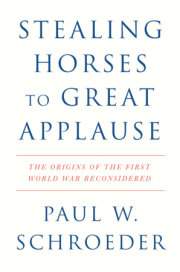
Stealing Horses to Great Applause

The Origins of the First World War Reconsidered

Look inside
Paperback
5.07"W x 7.8"H x 0.94"D   | 11 oz | 48 per carton
On sale Jun 16, 2026 | 384 Pages | 9781836745563

See Additional Formats
‘How had the world by 1914 become susceptible to a disastrous systemic breakdown? The one American historian who rose to this analytical challenge was Paul Schroeder. These historical insights have an obvious urgency today’

Nicholas Mulder, Financial Times


Stealing Horses to Great Applause is arguably the finest consideration yet of the origins of the First World War. Breaking with accounts focusing on the actions of a single state or the final countdown to hostilities, Paul W. Schroeder analyzes the systemic crisis that engulfed the Great Powers in 1914. Increasingly, they had become more interested in colonial expansion abroad (‘stealing horses to great applause’, in the old Spanish adage) than in the traditional conventions of European peacemaking. They forgot the rule that a balance of power required the preservation of all its essential actors, including the weakest of them, Austria-Hungary. This the British too failed to heed. The Central Powers may have started the war, but that does not mean they in any real sense caused it.

Stealing Horses includes appraisals of Niall Ferguson and A. J. P. Taylor as well as an extensive unpublished final work rethinking the First World War as ‘the last eighteenth-century war’.

With an introduction by Perry Anderson.
PAUL W. SCHROEDER (1927–2020) is the author of, among other things, The Trans-formation of European Politics, 1763–1848 and America’s Fatal Leap, 1991–2016. He taught history and political science at the University of Illinois for many years.
Available for sale exclusive:
•     Canada
•     Guam
•     Minor Outl.Ins.
•     North Mariana
•     Puerto Rico
•     Samoa,American
•     US Virgin Is.
•     USA

Not available for sale:
•     Afghanistan
•     Aland Islands
•     Albania
•     Algeria
•     Andorra
•     Angola
•     Anguilla
•     Antarctica
•     Antigua/Barbuda
•     Argentina
•     Armenia
•     Aruba
•     Australia
•     Austria
•     Azerbaijan
•     Bahamas
•     Bahrain
•     Bangladesh
•     Barbados
•     Belarus
•     Belgium
•     Belize
•     Benin
•     Bermuda
•     Bhutan
•     Bolivia
•     Bonaire, Saba
•     Bosnia Herzeg.
•     Botswana
•     Bouvet Island
•     Brazil
•     Brit.Ind.Oc.Ter
•     Brit.Virgin Is.
•     Brunei
•     Bulgaria
•     Burkina Faso
•     Burundi
•     Cambodia
•     Cameroon
•     Cape Verde
•     Cayman Islands
•     Centr.Afr.Rep.
•     Chad
•     Chile
•     China
•     Christmas Islnd
•     Cocos Islands
•     Colombia
•     Comoro Is.
•     Congo
•     Cook Islands
•     Costa Rica
•     Croatia
•     Cuba
•     Curacao
•     Cyprus
•     Czech Republic
•     Dem. Rep. Congo
•     Denmark
•     Djibouti
•     Dominica
•     Dominican Rep.
•     Ecuador
•     Egypt
•     El Salvador
•     Equatorial Gui.
•     Eritrea
•     Estonia
•     Ethiopia
•     Falkland Islnds
•     Faroe Islands
•     Fiji
•     Finland
•     France
•     Fren.Polynesia
•     French Guinea
•     Gabon
•     Gambia
•     Georgia
•     Germany
•     Ghana
•     Gibraltar
•     Greece
•     Greenland
•     Grenada
•     Guadeloupe
•     Guatemala
•     Guernsey
•     Guinea Republic
•     Guinea-Bissau
•     Guyana
•     Haiti
•     Heard/McDon.Isl
•     Honduras
•     Hong Kong
•     Hungary
•     Iceland
•     India
•     Indonesia
•     Iran
•     Iraq
•     Ireland
•     Isle of Man
•     Israel
•     Italy
•     Ivory Coast
•     Jamaica
•     Japan
•     Jersey
•     Jordan
•     Kazakhstan
•     Kenya
•     Kiribati
•     Kuwait
•     Kyrgyzstan
•     Laos
•     Latvia
•     Lebanon
•     Lesotho
•     Liberia
•     Libya
•     Liechtenstein
•     Lithuania
•     Luxembourg
•     Macau
•     Macedonia
•     Madagascar
•     Malawi
•     Malaysia
•     Maldives
•     Mali
•     Malta
•     Marshall island
•     Martinique
•     Mauritania
•     Mauritius
•     Mayotte
•     Mexico
•     Micronesia
•     Moldavia
•     Monaco
•     Mongolia
•     Montenegro
•     Montserrat
•     Morocco
•     Mozambique
•     Myanmar
•     Namibia
•     Nauru
•     Nepal
•     Netherlands
•     New Caledonia
•     New Zealand
•     Nicaragua
•     Niger
•     Nigeria
•     Niue
•     Norfolk Island
•     North Korea
•     Norway
•     Oman
•     Pakistan
•     Palau
•     Palestinian Ter
•     Panama
•     PapuaNewGuinea
•     Paraguay
•     Peru
•     Philippines
•     Pitcairn Islnds
•     Poland
•     Portugal
•     Qatar
•     Reunion Island
•     Romania
•     Russian Fed.
•     Rwanda
•     S. Sandwich Ins
•     Saint Martin
•     San Marino
•     SaoTome Princip
•     Saudi Arabia
•     Senegal
•     Serbia
•     Seychelles
•     Sierra Leone
•     Singapore
•     Sint Maarten
•     Slovakia
•     Slovenia
•     Solomon Islands
•     Somalia
•     South Africa
•     South Korea
•     South Sudan
•     Spain
•     Sri Lanka
•     St Barthelemy
•     St. Helena
•     St. Lucia
•     St. Vincent
•     St.Chr.,Nevis
•     St.Pier,Miquel.
•     Sth Terr. Franc
•     Sudan
•     Suriname
•     Svalbard
•     Swaziland
•     Sweden
•     Switzerland
•     Syria
•     Tadschikistan
•     Taiwan
•     Tanzania
•     Thailand
•     Timor-Leste
•     Togo
•     Tokelau Islands
•     Tonga
•     Trinidad,Tobago
•     Tunisia
•     Turkey
•     Turkmenistan
•     Turks&Caicos Is
•     Tuvalu
•     Uganda
•     Ukraine
•     Unit.Arab Emir.
•     United Kingdom
•     Uruguay
•     Uzbekistan
•     Vanuatu
•     Vatican City
•     Venezuela
•     Vietnam
•     Wallis,Futuna
•     West Saharan
•     Western Samoa
•     Yemen
•     Zambia
•     Zimbabwe

Introduction, Perry Anderson

PART I
1. World War I as Galloping Gertie: A Reply to Joachim Remak
2. International Politics, Peace and War, 1815–1914
3. Embedded Counterfactuals and World War I as an Unavoidable War
4. Stealing Horses to Great Applause: Austria-Hungary’s Decision in 1914 in Systemic Perspective
5. World War I and the Vienna System: The Last Eighteenth-Century War and the First Modern Peace

PART II
6. Romania and the Great Powers before 1914
7. Prudence vs Recklessness: Assessing Responsibility for World War I

PART III
8. World War I: A Tragedy, not a Pity
9. A. J. P. Taylor’s International System

Acknowledgments

Index

"A historian of remarkable chronological breadth and a fiercely independent mind. Great historians have a life, and they have an afterlife. Paul W. Schroeder’s may just have begun"
Times Literary Supplement

"Probably the foremost expert on the history of international politics in the world"
—Lothar Höbelt, International History Review

"A powerful intellect, a meticulous and innovative researcher who transformed his field"
—Katherine Aaslestad, Perspectives on History, the news magazine of the American Historical Association

"Perhaps the most distinguished diplomatic historian of his generation. He thought hard about the fundamental issues he was concerned with. What he had to say was always stimulating, always worth reading"
—Marc Trachtenberg, H-Diplo

"Few knew old Europe as intimately as Schroeder did. His cogent argument concerning the centrality of international relations is one which historians of all stripes ignore at their peril"
—Thomas Otte, author of Statesman of Europe

"A kaleidoscopic set of essays on the European state system in the century leading up to and during the Great War… written with calm and analytical rigor."
—Mathias Fuelling, Jacobin

"A gem that calls into question some of the standard interpretations of the war’s origins and its outbreak."
—Thomas Parker, H-Diplo

About

‘How had the world by 1914 become susceptible to a disastrous systemic breakdown? The one American historian who rose to this analytical challenge was Paul Schroeder. These historical insights have an obvious urgency today’

Nicholas Mulder, Financial Times


Stealing Horses to Great Applause is arguably the finest consideration yet of the origins of the First World War. Breaking with accounts focusing on the actions of a single state or the final countdown to hostilities, Paul W. Schroeder analyzes the systemic crisis that engulfed the Great Powers in 1914. Increasingly, they had become more interested in colonial expansion abroad (‘stealing horses to great applause’, in the old Spanish adage) than in the traditional conventions of European peacemaking. They forgot the rule that a balance of power required the preservation of all its essential actors, including the weakest of them, Austria-Hungary. This the British too failed to heed. The Central Powers may have started the war, but that does not mean they in any real sense caused it.

Stealing Horses includes appraisals of Niall Ferguson and A. J. P. Taylor as well as an extensive unpublished final work rethinking the First World War as ‘the last eighteenth-century war’.

With an introduction by Perry Anderson.

Creators

PAUL W. SCHROEDER (1927–2020) is the author of, among other things, The Trans-formation of European Politics, 1763–1848 and America’s Fatal Leap, 1991–2016. He taught history and political science at the University of Illinois for many years.

Table of Contents

Introduction, Perry Anderson

PART I
1. World War I as Galloping Gertie: A Reply to Joachim Remak
2. International Politics, Peace and War, 1815–1914
3. Embedded Counterfactuals and World War I as an Unavoidable War
4. Stealing Horses to Great Applause: Austria-Hungary’s Decision in 1914 in Systemic Perspective
5. World War I and the Vienna System: The Last Eighteenth-Century War and the First Modern Peace

PART II
6. Romania and the Great Powers before 1914
7. Prudence vs Recklessness: Assessing Responsibility for World War I

PART III
8. World War I: A Tragedy, not a Pity
9. A. J. P. Taylor’s International System

Acknowledgments

Index

Praise

"A historian of remarkable chronological breadth and a fiercely independent mind. Great historians have a life, and they have an afterlife. Paul W. Schroeder’s may just have begun"
Times Literary Supplement

"Probably the foremost expert on the history of international politics in the world"
—Lothar Höbelt, International History Review

"A powerful intellect, a meticulous and innovative researcher who transformed his field"
—Katherine Aaslestad, Perspectives on History, the news magazine of the American Historical Association

"Perhaps the most distinguished diplomatic historian of his generation. He thought hard about the fundamental issues he was concerned with. What he had to say was always stimulating, always worth reading"
—Marc Trachtenberg, H-Diplo

"Few knew old Europe as intimately as Schroeder did. His cogent argument concerning the centrality of international relations is one which historians of all stripes ignore at their peril"
—Thomas Otte, author of Statesman of Europe

"A kaleidoscopic set of essays on the European state system in the century leading up to and during the Great War… written with calm and analytical rigor."
—Mathias Fuelling, Jacobin

"A gem that calls into question some of the standard interpretations of the war’s origins and its outbreak."
—Thomas Parker, H-Diplo
Penguin Random House Comics Retail