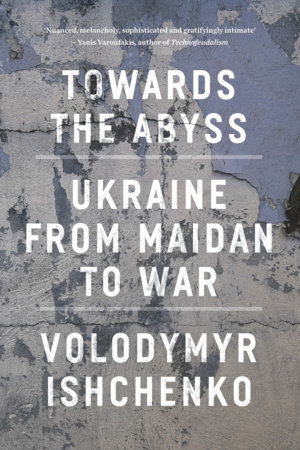
"Nuanced, melancholy, sophisticated and gratifyingly intimate." –Yanis Varoufakis, author of Technofeudalism
Ukrainian politics, the Russian invasion and the escalating crisis of the post-Soviet world
Towards the Abyss presents searching analysis of a decade of war and upheaval in Ukraine. Volodymyr Ishchenko has been among the left’s most significant commentators on Ukraine since 2014, when pro-EU protestors toppled the government in Kiev, Russia annexed Crimea and pro-Russian separatists seized parts of the Donbass. One of his first thoughts when he read the news of the full-scale Russian invasion on 24 February 2022 was that no matter how the war ends, he will no longer have a homeland.
What has happened in Ukraine ever since the Soviet collapse is a drawn-out process of de-modernization, and the downward spiral is getting faster. Ishchenko argues that the conflict being fought in Ukraine with tanks, artillery and rockets is the same conflict suppressed by police batons in Belarus and in Russia itself. The intensification of the post-Soviet crisis – the incapacity of an oligarchic ruling class in the territories of the former USSR to sustain political or moral leadership – is the root cause of the escalating violence.
Volodymyr Ishchenko was born in Hoshcha in western Ukraine in 1982. He grew up in Kiev, taught sociology at Kiev universities and was active in the Ukrainian new left. He is now a researcher at the Freie Universität in Berlin. His writing has appeared in the Guardian, Al Jazeera, Jacobin and New Left Review.
Preface: A Wrong Ukrainian Editorial Note 2014 1. Ukraine Protests Are No Longer Just about Europe 2. Maidan Mythologies 3. A Comedian in a Drama 4. From Ukraine with Comparisons 5. The Vicious Post-Soviet Circle with Oleg Zhuravlev 2022 6. Three Scenarios for the Ukraine–Russia Crisis 7. NATO through Ukrainian Eyes 8. Behind Russia’s War Is Thirty Years of Post-Soviet Class Conflict 9. Ukrainian Voices?
Interview: Towards the Abyss Notes Acknowledgements Index
"A nuanced, melancholy, sophisticated and gratifyingly intimate glimpse into war-torn Ukraine" —Yanis Varoufakis, author of Technofeudalism
"The huge choruses of these times will probably go down in history as mere noise. Might the lone voice of Ishchenko then sound prophetic?" —Georgi Derluguian, author of Bourdieu’s Secret Admirer in the Caucasus
"A brilliant cri de cœur from a Soviet Ukrainian searching the historical horizon for a political model beyond neoliberalism and regressive nationalism" —Dylan Riley, author of Microverses
"[A] pugnacious debut ... those wanting a better understanding of the Russia-Ukraine conflict would do well to check out this left-wing analysis." —Publishers Weekly
"A singular contribution to the rejuvenation of critical Eastern European scholarship ... the questions that Ishchenko raise[s] are itineraries for theoretical reflections and a hope ... for a modern and universalist politics worthy of its name" —Bogdan Ovcharuk, LeftEast
"The collection is valuable for its retrospective analysis, with Ishchenko's clear-eyed insights coming at a time when few dare to examine the still-fresh wound that is recent Ukrainian history, or to think about anything but the next few months of fighting." —Signe Swanson, Cleveland Review of Books
"A rare, but necessary, corrective to the currently dominant explanation of the roots of these events in the West." —Vladimir Unkovski-Korica, Counterfire
"A nuanced analysis, based on [Ischchenko's] understanding of the social, linguistic, political and economic divisions within Ukrainian society." —Duncan Bowie, Chartist
"An important corrective to analyses of Ukraine predominantly centered on ethnicity and personality ... Ishchenko's moral and passionate stance gives clues about how non-Ukrainian leftists should approach the Russian involvement in Ukraine" —Cihan Tugal, Jacobin
"Ishchenko’s work as a whole is convincing in its thorough examination of the post-Soviet space with a focus on Ukraine and Russia. He also delivers a passionate commitment to universalism, which, notwithstanding differences, recognizes general conditions for a good and self-determined life for all people, which can only be realized through revolutionary change." —Arman Spéth, Spectre Journal
"A cogent argument offering an urgent alternative to the dominant accounts of the warmakers in West and East and their celebration of civilizational identity politics that all but decapacitates our brains." —Focaal
"Nuanced, melancholy, sophisticated and gratifyingly intimate." –Yanis Varoufakis, author of Technofeudalism
Ukrainian politics, the Russian invasion and the escalating crisis of the post-Soviet world
Towards the Abyss presents searching analysis of a decade of war and upheaval in Ukraine. Volodymyr Ishchenko has been among the left’s most significant commentators on Ukraine since 2014, when pro-EU protestors toppled the government in Kiev, Russia annexed Crimea and pro-Russian separatists seized parts of the Donbass. One of his first thoughts when he read the news of the full-scale Russian invasion on 24 February 2022 was that no matter how the war ends, he will no longer have a homeland.
What has happened in Ukraine ever since the Soviet collapse is a drawn-out process of de-modernization, and the downward spiral is getting faster. Ishchenko argues that the conflict being fought in Ukraine with tanks, artillery and rockets is the same conflict suppressed by police batons in Belarus and in Russia itself. The intensification of the post-Soviet crisis – the incapacity of an oligarchic ruling class in the territories of the former USSR to sustain political or moral leadership – is the root cause of the escalating violence.
Creators
Volodymyr Ishchenko was born in Hoshcha in western Ukraine in 1982. He grew up in Kiev, taught sociology at Kiev universities and was active in the Ukrainian new left. He is now a researcher at the Freie Universität in Berlin. His writing has appeared in the Guardian, Al Jazeera, Jacobin and New Left Review.
Preface: A Wrong Ukrainian Editorial Note 2014 1. Ukraine Protests Are No Longer Just about Europe 2. Maidan Mythologies 3. A Comedian in a Drama 4. From Ukraine with Comparisons 5. The Vicious Post-Soviet Circle with Oleg Zhuravlev 2022 6. Three Scenarios for the Ukraine–Russia Crisis 7. NATO through Ukrainian Eyes 8. Behind Russia’s War Is Thirty Years of Post-Soviet Class Conflict 9. Ukrainian Voices?
Interview: Towards the Abyss Notes Acknowledgements Index
Praise
"A nuanced, melancholy, sophisticated and gratifyingly intimate glimpse into war-torn Ukraine" —Yanis Varoufakis, author of Technofeudalism
"The huge choruses of these times will probably go down in history as mere noise. Might the lone voice of Ishchenko then sound prophetic?" —Georgi Derluguian, author of Bourdieu’s Secret Admirer in the Caucasus
"A brilliant cri de cœur from a Soviet Ukrainian searching the historical horizon for a political model beyond neoliberalism and regressive nationalism" —Dylan Riley, author of Microverses
"[A] pugnacious debut ... those wanting a better understanding of the Russia-Ukraine conflict would do well to check out this left-wing analysis." —Publishers Weekly
"A singular contribution to the rejuvenation of critical Eastern European scholarship ... the questions that Ishchenko raise[s] are itineraries for theoretical reflections and a hope ... for a modern and universalist politics worthy of its name" —Bogdan Ovcharuk, LeftEast
"The collection is valuable for its retrospective analysis, with Ishchenko's clear-eyed insights coming at a time when few dare to examine the still-fresh wound that is recent Ukrainian history, or to think about anything but the next few months of fighting." —Signe Swanson, Cleveland Review of Books
"A rare, but necessary, corrective to the currently dominant explanation of the roots of these events in the West." —Vladimir Unkovski-Korica, Counterfire
"A nuanced analysis, based on [Ischchenko's] understanding of the social, linguistic, political and economic divisions within Ukrainian society." —Duncan Bowie, Chartist
"An important corrective to analyses of Ukraine predominantly centered on ethnicity and personality ... Ishchenko's moral and passionate stance gives clues about how non-Ukrainian leftists should approach the Russian involvement in Ukraine" —Cihan Tugal, Jacobin
"Ishchenko’s work as a whole is convincing in its thorough examination of the post-Soviet space with a focus on Ukraine and Russia. He also delivers a passionate commitment to universalism, which, notwithstanding differences, recognizes general conditions for a good and self-determined life for all people, which can only be realized through revolutionary change." —Arman Spéth, Spectre Journal
"A cogent argument offering an urgent alternative to the dominant accounts of the warmakers in West and East and their celebration of civilizational identity politics that all but decapacitates our brains." —Focaal