Close Modal

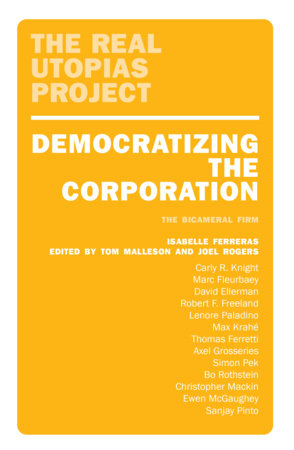
Democratizing the Corporation

The Bicameral Firm and Beyond

Look inside
Paperback
6"W x 9.18"H x 0.82"D   | 13 oz | 16 per carton
On sale Mar 19, 2024 | 336 Pages | 9781804294536

Worker representation is the first step toward democratizing the economy

Although contemporary Western societies refer to themselves as “democratic,” the bulk of the population spend much of their lives in workplaces that have more in common with tyranny. Gigantic corporations such as Amazon, Meta, Exxon, and Walmart are among the richest and most powerful institutions in the world yet accountable to no one but their shareholders. The undemocratic nature of conventional firms generates profound problems across society, hurting more than just the workplace and contributing to environmental destruction and spiraling inequality.

Against this backdrop, Isabelle Ferreras proposes a radical but realistic plan to democratize the private firm. She suggests that all large firms should be bicamerally governed, with a chamber of worker representatives sharing equal governance power with the standard board representing owners. In response to this proposal, twelve leading experts on corporate behavior from multiple disciplines consider its attractiveness, viability, and achievability as a “real utopian” proposal to strengthen democracy in our time.
Available for sale exclusive:
•     Canada
•     Guam
•     Minor Outl.Ins.
•     North Mariana
•     Puerto Rico
•     Samoa,American
•     US Virgin Is.
•     USA

Not available for sale:
•     Afghanistan
•     Aland Islands
•     Albania
•     Algeria
•     Andorra
•     Angola
•     Anguilla
•     Antarctica
•     Antigua/Barbuda
•     Argentina
•     Armenia
•     Aruba
•     Australia
•     Austria
•     Azerbaijan
•     Bahamas
•     Bahrain
•     Bangladesh
•     Barbados
•     Belarus
•     Belgium
•     Belize
•     Benin
•     Bermuda
•     Bhutan
•     Bolivia
•     Bonaire, Saba
•     Bosnia Herzeg.
•     Botswana
•     Bouvet Island
•     Brazil
•     Brit.Ind.Oc.Ter
•     Brit.Virgin Is.
•     Brunei
•     Bulgaria
•     Burkina Faso
•     Burundi
•     Cambodia
•     Cameroon
•     Cape Verde
•     Cayman Islands
•     Centr.Afr.Rep.
•     Chad
•     Chile
•     China
•     Christmas Islnd
•     Cocos Islands
•     Colombia
•     Comoro Is.
•     Congo
•     Cook Islands
•     Costa Rica
•     Croatia
•     Cuba
•     Curacao
•     Cyprus
•     Czech Republic
•     Dem. Rep. Congo
•     Denmark
•     Djibouti
•     Dominica
•     Dominican Rep.
•     Ecuador
•     Egypt
•     El Salvador
•     Equatorial Gui.
•     Eritrea
•     Estonia
•     Ethiopia
•     Falkland Islnds
•     Faroe Islands
•     Fiji
•     Finland
•     France
•     Fren.Polynesia
•     French Guinea
•     Gabon
•     Gambia
•     Georgia
•     Germany
•     Ghana
•     Gibraltar
•     Greece
•     Greenland
•     Grenada
•     Guadeloupe
•     Guatemala
•     Guernsey
•     Guinea Republic
•     Guinea-Bissau
•     Guyana
•     Haiti
•     Heard/McDon.Isl
•     Honduras
•     Hong Kong
•     Hungary
•     Iceland
•     India
•     Indonesia
•     Iran
•     Iraq
•     Ireland
•     Isle of Man
•     Israel
•     Italy
•     Ivory Coast
•     Jamaica
•     Japan
•     Jersey
•     Jordan
•     Kazakhstan
•     Kenya
•     Kiribati
•     Kuwait
•     Kyrgyzstan
•     Laos
•     Latvia
•     Lebanon
•     Lesotho
•     Liberia
•     Libya
•     Liechtenstein
•     Lithuania
•     Luxembourg
•     Macau
•     Macedonia
•     Madagascar
•     Malawi
•     Malaysia
•     Maldives
•     Mali
•     Malta
•     Marshall island
•     Martinique
•     Mauritania
•     Mauritius
•     Mayotte
•     Mexico
•     Micronesia
•     Moldavia
•     Monaco
•     Mongolia
•     Montenegro
•     Montserrat
•     Morocco
•     Mozambique
•     Myanmar
•     Namibia
•     Nauru
•     Nepal
•     Netherlands
•     New Caledonia
•     New Zealand
•     Nicaragua
•     Niger
•     Nigeria
•     Niue
•     Norfolk Island
•     North Korea
•     Norway
•     Oman
•     Pakistan
•     Palau
•     Palestinian Ter
•     Panama
•     PapuaNewGuinea
•     Paraguay
•     Peru
•     Philippines
•     Pitcairn Islnds
•     Poland
•     Portugal
•     Qatar
•     Reunion Island
•     Romania
•     Russian Fed.
•     Rwanda
•     S. Sandwich Ins
•     Saint Martin
•     San Marino
•     SaoTome Princip
•     Saudi Arabia
•     Senegal
•     Serbia
•     Seychelles
•     Sierra Leone
•     Singapore
•     Sint Maarten
•     Slovakia
•     Slovenia
•     Solomon Islands
•     Somalia
•     South Africa
•     South Korea
•     South Sudan
•     Spain
•     Sri Lanka
•     St Barthelemy
•     St. Helena
•     St. Lucia
•     St. Vincent
•     St.Chr.,Nevis
•     St.Pier,Miquel.
•     Sth Terr. Franc
•     Sudan
•     Suriname
•     Svalbard
•     Swaziland
•     Sweden
•     Switzerland
•     Syria
•     Tadschikistan
•     Taiwan
•     Tanzania
•     Thailand
•     Timor-Leste
•     Togo
•     Tokelau Islands
•     Tonga
•     Trinidad,Tobago
•     Tunisia
•     Turkey
•     Turkmenistan
•     Turks&Caicos Is
•     Tuvalu
•     Uganda
•     Ukraine
•     Unit.Arab Emir.
•     United Kingdom
•     Uruguay
•     Uzbekistan
•     Vanuatu
•     Vatican City
•     Venezuela
•     Vietnam
•     Wallis,Futuna
•     West Saharan
•     Western Samoa
•     Yemen
•     Zambia
•     Zimbabwe

Preface
Acknowledgments
Introduction, Tom Malleson and Joel Rogers

I. The Proposal
1. Democratizing the Corporation: The Proposal of the Bicameral Firm, Isabelle Ferreras

II. Democracy at Work
2. The Progressive Era’s Public Firm, Carly R. Knight
3. Workplace Democracy, the Bicameral Firm, and Stakeholder Theory, Marc Fleurbaey

III. The Corporation and the Law
4. Fallacies about Corporations: Comments on “Democratizing the Corporation,” David Ellerman
5. Prospects for Democratizing the Corporation in US Law, Robert F. Freeland
6. Economic Democracy at Work: Why (and How) Workers Should Be Represented on US Corporate Boards, Lenore Palladino

IV. Nuts and Bolts of Economic Bicameralism
7. Islands and the Sea: Making Firm-Level Democracy Durable, Max Krahé
8. Are Bicameral Firms Preferable to Codetermination or Worker Cooperatives? Thomas Ferretti and Axel Gosseries
9. Learning from Cooperatives to Strengthen Economic Bicameralism, Simon Pek

V. Economic Democracy: The Big Picture
10. The Prospects for Economic Democracy: Learning from Sweden as Failed Case, Bo Rothstein
11. Ferreras and the Economic Democracy Debate, Christopher Mackin
12. Five Principles of Economic Democracy, Ewan McGaughey
13. Economic Democracy against Racial Capitalism: Seeding Freedom, Sanjay Pinto

VI. Conclusion
14. A Response to My Readers, Isabelle Ferreras

Notes

"An essential book and a crucial discussion in order to rethink economic democracy and the structure of power relations within firms. A must-read!"
—Thomas Piketty (PSE-ENS, Paris)

"The idea that power should be held to account is widely accepted, but has been woefully neglected in economic relations. Ferreras' path breaking idea to govern firms like democratic governments by dividing rather than centralizing power offers a fertile ground for reimagining firms in the 21st century."
—Katharina Pistor (Edwin B. Parker Professor of Comparative Law & Director, Center on Global Legal Transformation, Columbia Law School, NYC)

"A landmark publication for anyone who believes that capitalism is not the end of history. We deserve a more democratic, just and sustainable economy, one step towards which might well be Isabelle Ferreras's visionary plan for economic bicameralism."
—Hélène Landemore (Full Professor in the Political Science department, Yale University Distinguished Researcher, Institute for Ethics in AI at the University of Oxford)

About

Worker representation is the first step toward democratizing the economy

Although contemporary Western societies refer to themselves as “democratic,” the bulk of the population spend much of their lives in workplaces that have more in common with tyranny. Gigantic corporations such as Amazon, Meta, Exxon, and Walmart are among the richest and most powerful institutions in the world yet accountable to no one but their shareholders. The undemocratic nature of conventional firms generates profound problems across society, hurting more than just the workplace and contributing to environmental destruction and spiraling inequality.

Against this backdrop, Isabelle Ferreras proposes a radical but realistic plan to democratize the private firm. She suggests that all large firms should be bicamerally governed, with a chamber of worker representatives sharing equal governance power with the standard board representing owners. In response to this proposal, twelve leading experts on corporate behavior from multiple disciplines consider its attractiveness, viability, and achievability as a “real utopian” proposal to strengthen democracy in our time.

Table of Contents

Preface
Acknowledgments
Introduction, Tom Malleson and Joel Rogers

I. The Proposal
1. Democratizing the Corporation: The Proposal of the Bicameral Firm, Isabelle Ferreras

II. Democracy at Work
2. The Progressive Era’s Public Firm, Carly R. Knight
3. Workplace Democracy, the Bicameral Firm, and Stakeholder Theory, Marc Fleurbaey

III. The Corporation and the Law
4. Fallacies about Corporations: Comments on “Democratizing the Corporation,” David Ellerman
5. Prospects for Democratizing the Corporation in US Law, Robert F. Freeland
6. Economic Democracy at Work: Why (and How) Workers Should Be Represented on US Corporate Boards, Lenore Palladino

IV. Nuts and Bolts of Economic Bicameralism
7. Islands and the Sea: Making Firm-Level Democracy Durable, Max Krahé
8. Are Bicameral Firms Preferable to Codetermination or Worker Cooperatives? Thomas Ferretti and Axel Gosseries
9. Learning from Cooperatives to Strengthen Economic Bicameralism, Simon Pek

V. Economic Democracy: The Big Picture
10. The Prospects for Economic Democracy: Learning from Sweden as Failed Case, Bo Rothstein
11. Ferreras and the Economic Democracy Debate, Christopher Mackin
12. Five Principles of Economic Democracy, Ewan McGaughey
13. Economic Democracy against Racial Capitalism: Seeding Freedom, Sanjay Pinto

VI. Conclusion
14. A Response to My Readers, Isabelle Ferreras

Notes

Praise

"An essential book and a crucial discussion in order to rethink economic democracy and the structure of power relations within firms. A must-read!"
—Thomas Piketty (PSE-ENS, Paris)

"The idea that power should be held to account is widely accepted, but has been woefully neglected in economic relations. Ferreras' path breaking idea to govern firms like democratic governments by dividing rather than centralizing power offers a fertile ground for reimagining firms in the 21st century."
—Katharina Pistor (Edwin B. Parker Professor of Comparative Law & Director, Center on Global Legal Transformation, Columbia Law School, NYC)

"A landmark publication for anyone who believes that capitalism is not the end of history. We deserve a more democratic, just and sustainable economy, one step towards which might well be Isabelle Ferreras's visionary plan for economic bicameralism."
—Hélène Landemore (Full Professor in the Political Science department, Yale University Distinguished Researcher, Institute for Ethics in AI at the University of Oxford)
Penguin Random House Comics Retail