Close Modal

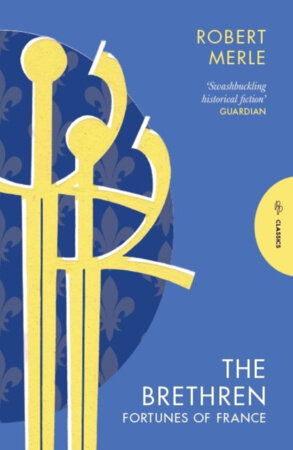
The Brethren

Fortunes of France: Volume 1

Translated by T. Jefferson Kline
Paperback
5-1/16"W x 7-13/16"H | 13 oz | 24 per carton
On sale Aug 25, 2026 | 416 Pages | 9781782695363

A stunning new edition of the first novel in worldwide, bestselling historical fiction epic, filled with war, romance, and adventure in 16th-century France.

“A master of the historical novel.” – The Guardian


The Périgord of 16th century France (the modern-day Dordogne) is a wild region on the edge of the reaches of royal authority. Its steep, forested valleys are roamed by bands of brigands and travelers. The region’s communities are now divided in bitter conflict between Catholics and converts to the new Protestant faith, the Huguenots.

To this beautiful but dangerous country come two worn veterans of the French king's wars, Jean de Siorac and Jean de Sauveterre, together known as The Brethren. They are as fiercely loyal to the crown as they are to their Huguenot religion. They make their home in the formidable chateau of Mespech, and the community they found prospers, but they are far from secure. Enemies are on all sides, invisible. Religious tensions are mounting and a hideous civil war looms on the horizon. The horrors of famine and plague stalk the land, and The Brethren must use all their wits to protect those they love from the chaos that threatens to sweep them away.

The Brethren is a lusty, exhilarating blend of adventure and romance set against the backdrop of France during England’s Tudor period. This is the novel that catapulted Robert Merle to fame and started what would become the bestselling, 13-volume Fortunes of France series.
Robert Merle (1908-2004) was born in French Algeria, before moving to mainland France in 1918. Originally an English teacher, Merle served as an interpreter with British Expeditionary Force during the Second World War, and was captured by the German army at Dunkirk, the experience of which served as the basis for his Goncourt-prize-winning Weekend at Zuydocoote. He published the 13 volumes of his hugely popular Fortunes of France series over four decades, from 1977 to 2003, the final volume appearing just a year before his death of a heart attack in 2004.

T. Jefferson Kline is professor emeritus of French at Boston University. He is editor of Agnès Varda: Interviews and coeditor of Bertrand Tavernier: Interviews and Bernardo Bertolucci: Interviews, all published by University Press of Mississippi. His translations of the first three volumes of Robert Merle’s Fortunes of France series are all available from Pushkin Press.
Available for sale exclusive:
•     Canada
•     Dominica
•     Falkland Islnds
•     Guam
•     Minor Outl.Ins.
•     Puerto Rico
•     Samoa,American
•     Sierra Leone
•     US Virgin Is.
•     USA
•     Western Samoa

Available for sale non-exclusive:
•     Afghanistan
•     Aland Islands
•     Albania
•     Angola
•     Anguilla
•     Antarctica
•     Argentina
•     Armenia
•     Bhutan
•     Bolivia
•     Bonaire, Saba
•     Bouvet Island
•     Brazil
•     Burkina Faso
•     Burundi
•     Cambodia
•     Cameroon
•     Cape Verde
•     Centr.Afr.Rep.
•     Chad
•     Chile
•     China
•     Colombia
•     Comoro Is.
•     Congo
•     Cook Islands
•     Costa Rica
•     Cuba
•     Djibouti
•     Dominican Rep.
•     Ecuador
•     El Salvador
•     Equatorial Gui.
•     Eritrea
•     Ethiopia
•     Faroe Islands
•     Fren.Polynesia
•     French Guinea
•     Gabon
•     Georgia
•     Guadeloupe
•     Guatemala
•     Guinea Republic
•     Guinea-Bissau
•     Haiti
•     Heard/McDon.Isl
•     Honduras
•     Hong Kong
•     Kuwait
•     Kyrgyzstan
•     Lebanon
•     Liberia
•     Macau
•     Madagascar
•     Maldives
•     Marshall island
•     Martinique
•     Mauritania
•     Mayotte
•     Mexico
•     Micronesia
•     Moldavia
•     Monaco
•     Mongolia
•     Montenegro
•     Morocco
•     New Caledonia
•     Nicaragua
•     Niger
•     Niue
•     Norfolk Island
•     North Korea
•     Palau
•     Palestinian Ter
•     Panama
•     Paraguay
•     Peru
•     Qatar
•     Russian Fed.
•     Rwanda
•     Saint Martin
•     San Marino
•     SaoTome Princip
•     Saudi Arabia
•     Serbia
•     South Sudan
•     St Barthelemy
•     St.Pier,Miquel.
•     Syria
•     Tadschikistan
•     Taiwan
•     Togo
•     Turkey
•     Turkmenistan
•     Ukraine
•     Unit.Arab Emir.
•     Uruguay
•     Uzbekistan
•     Vatican City
•     Venezuela
•     Vietnam
•     Wallis,Futuna
•     West Saharan
•     Yemen

Not available for sale:
•     Algeria
•     Andorra
•     Antigua/Barbuda
•     Aruba
•     Australia
•     Austria
•     Azerbaijan
•     Bahamas
•     Bahrain
•     Bangladesh
•     Barbados
•     Belarus
•     Belgium
•     Belize
•     Benin
•     Bermuda
•     Bosnia Herzeg.
•     Botswana
•     Brit.Ind.Oc.Ter
•     Brit.Virgin Is.
•     Brunei
•     Bulgaria
•     Cayman Islands
•     Christmas Islnd
•     Cocos Islands
•     Croatia
•     Curacao
•     Cyprus
•     Czech Republic
•     Dem. Rep. Congo
•     Denmark
•     Egypt
•     Estonia
•     Fiji
•     Finland
•     France
•     Gambia
•     Germany
•     Ghana
•     Gibraltar
•     Greece
•     Greenland
•     Grenada
•     Guernsey
•     Guyana
•     Hungary
•     Iceland
•     India
•     Indonesia
•     Iran
•     Iraq
•     Ireland
•     Isle of Man
•     Israel
•     Italy
•     Ivory Coast
•     Jamaica
•     Japan
•     Jersey
•     Jordan
•     Kazakhstan
•     Kenya
•     Kiribati
•     Laos
•     Latvia
•     Lesotho
•     Libya
•     Liechtenstein
•     Lithuania
•     Luxembourg
•     Macedonia
•     Malawi
•     Malaysia
•     Mali
•     Malta
•     Mauritius
•     Montserrat
•     Mozambique
•     Myanmar
•     Namibia
•     Nauru
•     Nepal
•     Netherlands
•     New Zealand
•     Nigeria
•     North Mariana
•     Norway
•     Oman
•     Pakistan
•     PapuaNewGuinea
•     Philippines
•     Pitcairn Islnds
•     Poland
•     Portugal
•     Reunion Island
•     Romania
•     S. Sandwich Ins
•     Senegal
•     Seychelles
•     Singapore
•     Sint Maarten
•     Slovakia
•     Slovenia
•     Solomon Islands
•     Somalia
•     South Africa
•     South Korea
•     Spain
•     Sri Lanka
•     St. Helena
•     St. Lucia
•     St. Vincent
•     St.Chr.,Nevis
•     Sth Terr. Franc
•     Sudan
•     Suriname
•     Svalbard
•     Swaziland
•     Sweden
•     Switzerland
•     Tanzania
•     Thailand
•     Timor-Leste
•     Tokelau Islands
•     Tonga
•     Trinidad,Tobago
•     Tunisia
•     Turks&Caicos Is
•     Tuvalu
•     Uganda
•     United Kingdom
•     Vanuatu
•     Zambia
•     Zimbabwe

My family's claim to nobility does not extend very far back. In fact, it originates with my father. I say this without the least sense of shame. You must understand that if I were out to hide anything I would never have begun this story at all. My design is to write it straight out, without any deviation, the way you’d go about ploughing a field.

Some have dared to claim that my great-grandfather was a mere lackey: a falsehood which I shall be glad to prove to anyone who will listen. In fact, my great-grandfather, François Siorac, never served a day under anyone. He owned and worked with his own hands a rich piece of farmland near Taniès, in the Sarlat region. I cannot tell you the exact extent of his land, but it was neither small nor unproductive, judging by the fact that he paid the highest tithes to the king of any man in his parish. Nor was he a miser, since he gave ten sols a month to his curate so that his younger son Charles could study Latin, hoping, no doubt, to see him become a priest in his turn. My grandfather Charles was a handsome man, whose beard and hair verged on red, like my half-brother Samson’s. He learnt his Latin well, but preferred adventures to sermons: at eighteen he left his village to seek his fortune in the north.

He found it, apparently, since he married the daughter of an apoth-ecary from Rouen, to whom he was apprenticed. I cannot imagine how, being an apprentice, he managed to study for his apothecary’s exams, nor do I even know whether he passed them or not, but at the death of his father-in-law he took over his shop and did remarkably well. In 1514, the year my father was born, he was prosperous enough to acquire a mill surrounded by good farmland, some ten leagues from Rouen, which he named la Volpie. It was at this time that between “Charles” and “Siorac” the particle “de” was inserted to indicate nobil-ity, an addition my father made much sport of, but maintained. And yet I’ve never seen on any of the documents preserved by my father the title “nobleman” preceding the signature “Charles de Siorac, lord of la Volpie”: proof that my grandfather wasn’t out to fool anyone, like so many bourgeois who acquire land only to lay claim to a title never granted them by the king. False nobles abound, as everyone knows. And, to tell the truth, when these bourgeois fortunes grow fat enough to merit an alliance, the real nobles don’t look too closely.

My father, Jean de Siorac, was a younger brother, like his father Charles before him and like me. And Charles, remembering the costly Latin lessons old François Siorac had provided for him, sent Jean off to learn his medicine in Montpellier. It was a long journey requiring a lengthy stay and a great sacrifice of capital, even for an apothecary. As he grew older, however, Charles’s great dream was—God willing—to see his eldest son Henri settled in his apothecary’s shop, his younger son Jean established as a doctor in town, and the two of them, squeezing the patient from either side, prospering grandly. His three daughters counted but little for him, yet he provided each of them enough in dowry so that he should never be ashamed of their station.
My father received his bachelor’s degree with a licence in medi-cine from the University of Montpellier, but he never defended his thesis. He was forced to flee the town two days before his defence, fearing that his last look would be heavenward as he dangled from a noose, after which he would be quartered and, as was the custom of the place, his quarters hung from olive branches at each of the town gates. This fact gave me cause to shudder when, in my turn, I entered Montpellier one sunny morn, thirty years later, and confronted the rotting remains of some women, hanged from the branches of these trees, shamelessly laden, as if with their own profusion of fruit.

Today, I have trouble imagining my father thirty years ago, just as wild as I am now, and no less attracted by a pretty skirt. Yet it is undoubtedly over some unworthy wench that my father fought an honourable duel and skewered the body of a petty nobleman who had provoked him. An hour later, spying the archers coming to arrest him in his attic, Jean de Siorac jumped from a rear window onto his horse (luckily still saddled), and galloped full tilt out of town. Bareheaded and dressed only in his doublet, with neither coat nor sword, he headed towards the hills of Cévennes. There he sought refuge with a student who was spending six months in the mountains preparing his medical exams for Montpellier. He later crossed the Auvergne region and headed to Périgord, where old François Siorac armed and clothed him at his own expense and sent him on to the home of his son Charles in Rouen.

By this time a formal complaint had been lodged with the parlia-ment of Aix by the parents of the late petty nobleman. They suc-ceeded in making such an enormous stir that even my grandfather’s considerable influence as apothecary of Rouen did not make it safe for Jean de Siorac to show himself in daylight.

All of this transpired in the same year that our great king, François I, ordered the conscription of a legion of soldiers from each of the provinces of his kingdom. This was a wise decision, which, had it been continued, would have spared us the wartime use of the Swiss Guard, who fought bravely enough when they were paid, but, when they weren’t, set about pillaging the poor peasants of France faster than our enemies could.

The Norman legion, a full 6,000 strong, was the first to be formed in all of France, and Jean de Siorac enlisted when the king promised to consider a pardon for the murder he had committed. Indeed, when François I inspected the regiment in May 1535, he was so happy that he granted my father’s immediate pardon on condition that he serve five years in the army. “And so,” as Jean de Siorac tells it, “it came to pass that, having learnt the art of healing my fellow men, I had taken up the trade of killing them.”

My grandfather Charles was not a little chagrined to see his younger son recruited as a legionnaire after having spent so many écus to educate him to be a doctor in the town. His sorrow was com-pounded by his elder son Henry’s behaviour. The future apothecary neglected his studies for drinking and merrymaking, and ended up in the Seine one night drowned (with a little help, evidently, since his pockets had first been carefully emptied).

My grandfather was greatly relieved that the daughter he had always called a “silly gossip”, but who was not lacking in common sense, furnished him with a son-in-law capable of inheriting his shop. ’Tis strange indeed that his apothecary’s shop was passed on for the second time not from father to son, but from father-in-law to son-in-law.

As for my father, Jean de Siorac, he was cast of a very different metal from his elder brother. He set about bravely advancing his fortunes in the legion. He was courageous, patient and tolerant, and, though he never breathed a word of his medical training (for fear of ending up in the medical corps, a role he would have disdained), he treated and bandaged his companions’ wounds, which earned him the goodwill of his commanders and comrades alike.

In all, he served not five, but nine years in the legion, from 1536 to 1545, and in each campaign received a wound and a promotion. From centurion he rose to standard-bearer and from this rank to lieutenant. From lieutenant, in 1544, having been stabbed or shot in every part of his body but the vital ones, he was promoted to captain. This rank was as high as any enlisted man could aspire to and meant the command of 1,000 legionnaires, pay of 100 livres during each month of a campaign and the lion’s share of any booty pillaged from captured towns. It turned out to be an even greater privilege for my father, for it eventually led to his ennoblement as écuyer, or squire—justly and honourably won by valour rather than by wealth or advantageous marriage vows.

The day my father was named captain, they also promoted his friend and steadfast companion, Jean de Sauveterre. Between these two were woven, out of the hazards of battle and their many brushes with death from which each had saved the other, the ties of an affection so deep that neither time, misfortune nor even my father’s marriage could damage it in the slightest. Jean de Sauveterre was about five years older than my father and was as swarthy as my father was blond, with brown eyes, a badly scarred face and a most reticent tongue.

My father didn’t remain an écuyer for very long. In 1545, he fought so valiantly at Ceresole that he was knighted on the battlefield by his commander, the Duc d’Enghien. My father’s joy was severely compromised, however, by the news that Jean de Sauveterre had received a leg wound so grave as to cause him to limp for the rest of his days. With the return of peace, the best Jean de Sauveterre could look forward to would be some stationary post in a fortress that would have separated him from the other Jean—a thought as unbearable to the one as to the other.

They were plunged in gloomy ruminations about their future when news reached them of the death of my grandfather Charles. He’d scarcely had time to enjoy all the attention his younger son’s military successes had brought to the family. He had been announcing to all his friends in Rouen the upcoming visit of his son, the “Chevalier de Siorac”, when he was overcome with a terrible intestinal pain—a miserere, or appendicitis, according to what I heard. He died, sweating and in terrible pain, before he could see his son, his sole surviving male heir and the only one of his children he had ever really loved, since, as I have said, he considered his daughters worthless.

Jean, Chevalier de Siorac, collected his part of the inheritance, which amounted to 7,537 livres, and, upon his return to camp, sequestered himself in his tent with Jean de Sauveterre to do their accounts. Since both had been careful with their expenses, addicted neither to wine nor to gambling, they had managed to save most of their pay and the greater part of their booty. Moreover, having entrusted the greater part of their savings to an honest Jew in Rouen, each had prospered through his usury and now found that together they possessed some 35,000 livres—a sum large enough to permit them to purchase a farm together, from which they agreed to share all profits and losses.

With the reluctant permission of the lieutenant general, the two Jeans left the Norman legion, taking with them their arms, their horses, their booty and three good foot soldiers in their service. One of these drove a cart bearing all their worldly goods, including an assortment of loaded pistols, blunderbusses and firearms confiscated from their enemies. From Normandy to Périgord, the roads were long and dangerous, and the small troop rode prudently, avoiding large groups of horsemen and cutting to pieces the petty thieves who dared demand payment for bridge crossings. After each band of these scoundrels was dispatched, they were relieved of arms and treasure, a part of the booty going to each of the three soldiers and the rest into the coffers of the two leaders.

"There is a philosophical depth to the novel. . . one of the strengths of Merle’s novels [is] his ability to evoke the feeling and texture of everyday life as well as high politics. . . [The Brethren] has a credibly human solidity, and whets one’s appetite for the next volume, “City of Wisdom and Blood,” which will be published in the fall." — The Wall Street Journal

"One of the many delights vouchsafed by Robert Merle's The Brethren is the sense that the author is astonished that what he's writing about actually happened. . . If there is a pattern to the narration—a dependable vacillation between personal exploit and public machination—the chronicle is also seductively contorted, with adventures sowed into other adventures. . . Pierre, then, is the human demilitarized zone separating his mother and father. His voice can be self-congratulatory though also generous and gently philosophical, reminiscent at moments of Merle's colleague Sartre. . . Feudal life can hardly seem more vivid than when Merle leaves the religious war to describe, through a smart translation by T. Jefferson Kline, a soul-strengthening day of haymaking or the swagger of a barrel-chested wet nurse with 'milk for sale.' Merle the English teacher repeatedly bows to Shakespeare. . . [The Brethren] is wise and audacious, constantly nudging up against the extraordinary." — The New York Times Book Review


"The compelling first in a series of French historical novels, deftly translated and published for the first time in English. Château Mespech is a fiefdom relentlessly imperiled by the weather, Gypsy bandits, royal and religious duplicity, and the plague . . . Merle peoples his tale with memorable characters: villains, maids, legionnaires and townsfolk . . . Merle's is a French epic, more genteel than Dickens' poor-child English tales and less doleful than Tolstoy's Russian sagas." -- Kirkus Reviews

"Swashbuckling historical fiction... For all its philosophical depth [The Brethren] is a hugely entertaining romp... The comparisons with Dumas seem both natural and deserved and the next 12 instalments [are] a thrilling prospect." — Guardian
 
"A vivid novel by France's modern Dumas... [there is] plenty of evidence in the rich characterisation and vivid historical detail that a reader's long-term commitment will be amply rewarded." — Sunday Times
 
"Cleverly depicts France’s epic religious wars through the intimate prism of one family’s experience. It’s beautifully written too." — Metro.
 
"We're swept away by triumph, tragedy, action and adventure… It's a novel like this that makes reviewing one of the best jobs in the world." — The Book Bag, Five Star Review
 
“Historical fiction at its very best… The second instalment cannot be published too soon.” — We Love This Book
 
“A Sprawling, earthy tale of peril, love, lust, death, dazzling philosophical debate and political intrigue… an engrossing saga.” Gransnet
 
"A master of the historical novel." — Guardian
 
"A spectacular evocation of sixteenth- and seventeenth-century France." — Independent
 
Advance Praise from Europe:
 
"His readers appreciate his recipe for writing that is as political as it is entertaining." — Deutschlandfunk
 
"Be warned: even just a few pages can lead to addiction." — Neckar-Tauber Trend
 
"With much wit, irony and a knack for juicy details, [Merle] brings alive his country's history." — Literatur-Report
 
"For fans of historical fiction, The Brethren is a delight to savour." — Thüringer Allgemeine
 
"Thrilling! Robert Merle rides his novel at full tilt across a richly eventful period of history." — Le Magazine Littéraire
 
"Robert Merle is one of the very few French writers who have attained both popular success and the admiration of critics." — Le Figaro
 
"A wonderful, colourful, breathlessly narrated historical panorama." — Zeitpunkt
 
"Breathes new life into the classic adventure story and great historical epic." — Les Nouvelles Littéraires
 
"France's greatest popular novelist." — Le Monde
 
"The Dumas of the twentieth century." — Neues Deutschland 

About

A stunning new edition of the first novel in worldwide, bestselling historical fiction epic, filled with war, romance, and adventure in 16th-century France.

“A master of the historical novel.” – The Guardian


The Périgord of 16th century France (the modern-day Dordogne) is a wild region on the edge of the reaches of royal authority. Its steep, forested valleys are roamed by bands of brigands and travelers. The region’s communities are now divided in bitter conflict between Catholics and converts to the new Protestant faith, the Huguenots.

To this beautiful but dangerous country come two worn veterans of the French king's wars, Jean de Siorac and Jean de Sauveterre, together known as The Brethren. They are as fiercely loyal to the crown as they are to their Huguenot religion. They make their home in the formidable chateau of Mespech, and the community they found prospers, but they are far from secure. Enemies are on all sides, invisible. Religious tensions are mounting and a hideous civil war looms on the horizon. The horrors of famine and plague stalk the land, and The Brethren must use all their wits to protect those they love from the chaos that threatens to sweep them away.

The Brethren is a lusty, exhilarating blend of adventure and romance set against the backdrop of France during England’s Tudor period. This is the novel that catapulted Robert Merle to fame and started what would become the bestselling, 13-volume Fortunes of France series.

Creators

Robert Merle (1908-2004) was born in French Algeria, before moving to mainland France in 1918. Originally an English teacher, Merle served as an interpreter with British Expeditionary Force during the Second World War, and was captured by the German army at Dunkirk, the experience of which served as the basis for his Goncourt-prize-winning Weekend at Zuydocoote. He published the 13 volumes of his hugely popular Fortunes of France series over four decades, from 1977 to 2003, the final volume appearing just a year before his death of a heart attack in 2004.

T. Jefferson Kline is professor emeritus of French at Boston University. He is editor of Agnès Varda: Interviews and coeditor of Bertrand Tavernier: Interviews and Bernardo Bertolucci: Interviews, all published by University Press of Mississippi. His translations of the first three volumes of Robert Merle’s Fortunes of France series are all available from Pushkin Press.

Excerpt

My family's claim to nobility does not extend very far back. In fact, it originates with my father. I say this without the least sense of shame. You must understand that if I were out to hide anything I would never have begun this story at all. My design is to write it straight out, without any deviation, the way you’d go about ploughing a field.

Some have dared to claim that my great-grandfather was a mere lackey: a falsehood which I shall be glad to prove to anyone who will listen. In fact, my great-grandfather, François Siorac, never served a day under anyone. He owned and worked with his own hands a rich piece of farmland near Taniès, in the Sarlat region. I cannot tell you the exact extent of his land, but it was neither small nor unproductive, judging by the fact that he paid the highest tithes to the king of any man in his parish. Nor was he a miser, since he gave ten sols a month to his curate so that his younger son Charles could study Latin, hoping, no doubt, to see him become a priest in his turn. My grandfather Charles was a handsome man, whose beard and hair verged on red, like my half-brother Samson’s. He learnt his Latin well, but preferred adventures to sermons: at eighteen he left his village to seek his fortune in the north.

He found it, apparently, since he married the daughter of an apoth-ecary from Rouen, to whom he was apprenticed. I cannot imagine how, being an apprentice, he managed to study for his apothecary’s exams, nor do I even know whether he passed them or not, but at the death of his father-in-law he took over his shop and did remarkably well. In 1514, the year my father was born, he was prosperous enough to acquire a mill surrounded by good farmland, some ten leagues from Rouen, which he named la Volpie. It was at this time that between “Charles” and “Siorac” the particle “de” was inserted to indicate nobil-ity, an addition my father made much sport of, but maintained. And yet I’ve never seen on any of the documents preserved by my father the title “nobleman” preceding the signature “Charles de Siorac, lord of la Volpie”: proof that my grandfather wasn’t out to fool anyone, like so many bourgeois who acquire land only to lay claim to a title never granted them by the king. False nobles abound, as everyone knows. And, to tell the truth, when these bourgeois fortunes grow fat enough to merit an alliance, the real nobles don’t look too closely.

My father, Jean de Siorac, was a younger brother, like his father Charles before him and like me. And Charles, remembering the costly Latin lessons old François Siorac had provided for him, sent Jean off to learn his medicine in Montpellier. It was a long journey requiring a lengthy stay and a great sacrifice of capital, even for an apothecary. As he grew older, however, Charles’s great dream was—God willing—to see his eldest son Henri settled in his apothecary’s shop, his younger son Jean established as a doctor in town, and the two of them, squeezing the patient from either side, prospering grandly. His three daughters counted but little for him, yet he provided each of them enough in dowry so that he should never be ashamed of their station.
My father received his bachelor’s degree with a licence in medi-cine from the University of Montpellier, but he never defended his thesis. He was forced to flee the town two days before his defence, fearing that his last look would be heavenward as he dangled from a noose, after which he would be quartered and, as was the custom of the place, his quarters hung from olive branches at each of the town gates. This fact gave me cause to shudder when, in my turn, I entered Montpellier one sunny morn, thirty years later, and confronted the rotting remains of some women, hanged from the branches of these trees, shamelessly laden, as if with their own profusion of fruit.

Today, I have trouble imagining my father thirty years ago, just as wild as I am now, and no less attracted by a pretty skirt. Yet it is undoubtedly over some unworthy wench that my father fought an honourable duel and skewered the body of a petty nobleman who had provoked him. An hour later, spying the archers coming to arrest him in his attic, Jean de Siorac jumped from a rear window onto his horse (luckily still saddled), and galloped full tilt out of town. Bareheaded and dressed only in his doublet, with neither coat nor sword, he headed towards the hills of Cévennes. There he sought refuge with a student who was spending six months in the mountains preparing his medical exams for Montpellier. He later crossed the Auvergne region and headed to Périgord, where old François Siorac armed and clothed him at his own expense and sent him on to the home of his son Charles in Rouen.

By this time a formal complaint had been lodged with the parlia-ment of Aix by the parents of the late petty nobleman. They suc-ceeded in making such an enormous stir that even my grandfather’s considerable influence as apothecary of Rouen did not make it safe for Jean de Siorac to show himself in daylight.

All of this transpired in the same year that our great king, François I, ordered the conscription of a legion of soldiers from each of the provinces of his kingdom. This was a wise decision, which, had it been continued, would have spared us the wartime use of the Swiss Guard, who fought bravely enough when they were paid, but, when they weren’t, set about pillaging the poor peasants of France faster than our enemies could.

The Norman legion, a full 6,000 strong, was the first to be formed in all of France, and Jean de Siorac enlisted when the king promised to consider a pardon for the murder he had committed. Indeed, when François I inspected the regiment in May 1535, he was so happy that he granted my father’s immediate pardon on condition that he serve five years in the army. “And so,” as Jean de Siorac tells it, “it came to pass that, having learnt the art of healing my fellow men, I had taken up the trade of killing them.”

My grandfather Charles was not a little chagrined to see his younger son recruited as a legionnaire after having spent so many écus to educate him to be a doctor in the town. His sorrow was com-pounded by his elder son Henry’s behaviour. The future apothecary neglected his studies for drinking and merrymaking, and ended up in the Seine one night drowned (with a little help, evidently, since his pockets had first been carefully emptied).

My grandfather was greatly relieved that the daughter he had always called a “silly gossip”, but who was not lacking in common sense, furnished him with a son-in-law capable of inheriting his shop. ’Tis strange indeed that his apothecary’s shop was passed on for the second time not from father to son, but from father-in-law to son-in-law.

As for my father, Jean de Siorac, he was cast of a very different metal from his elder brother. He set about bravely advancing his fortunes in the legion. He was courageous, patient and tolerant, and, though he never breathed a word of his medical training (for fear of ending up in the medical corps, a role he would have disdained), he treated and bandaged his companions’ wounds, which earned him the goodwill of his commanders and comrades alike.

In all, he served not five, but nine years in the legion, from 1536 to 1545, and in each campaign received a wound and a promotion. From centurion he rose to standard-bearer and from this rank to lieutenant. From lieutenant, in 1544, having been stabbed or shot in every part of his body but the vital ones, he was promoted to captain. This rank was as high as any enlisted man could aspire to and meant the command of 1,000 legionnaires, pay of 100 livres during each month of a campaign and the lion’s share of any booty pillaged from captured towns. It turned out to be an even greater privilege for my father, for it eventually led to his ennoblement as écuyer, or squire—justly and honourably won by valour rather than by wealth or advantageous marriage vows.

The day my father was named captain, they also promoted his friend and steadfast companion, Jean de Sauveterre. Between these two were woven, out of the hazards of battle and their many brushes with death from which each had saved the other, the ties of an affection so deep that neither time, misfortune nor even my father’s marriage could damage it in the slightest. Jean de Sauveterre was about five years older than my father and was as swarthy as my father was blond, with brown eyes, a badly scarred face and a most reticent tongue.

My father didn’t remain an écuyer for very long. In 1545, he fought so valiantly at Ceresole that he was knighted on the battlefield by his commander, the Duc d’Enghien. My father’s joy was severely compromised, however, by the news that Jean de Sauveterre had received a leg wound so grave as to cause him to limp for the rest of his days. With the return of peace, the best Jean de Sauveterre could look forward to would be some stationary post in a fortress that would have separated him from the other Jean—a thought as unbearable to the one as to the other.

They were plunged in gloomy ruminations about their future when news reached them of the death of my grandfather Charles. He’d scarcely had time to enjoy all the attention his younger son’s military successes had brought to the family. He had been announcing to all his friends in Rouen the upcoming visit of his son, the “Chevalier de Siorac”, when he was overcome with a terrible intestinal pain—a miserere, or appendicitis, according to what I heard. He died, sweating and in terrible pain, before he could see his son, his sole surviving male heir and the only one of his children he had ever really loved, since, as I have said, he considered his daughters worthless.

Jean, Chevalier de Siorac, collected his part of the inheritance, which amounted to 7,537 livres, and, upon his return to camp, sequestered himself in his tent with Jean de Sauveterre to do their accounts. Since both had been careful with their expenses, addicted neither to wine nor to gambling, they had managed to save most of their pay and the greater part of their booty. Moreover, having entrusted the greater part of their savings to an honest Jew in Rouen, each had prospered through his usury and now found that together they possessed some 35,000 livres—a sum large enough to permit them to purchase a farm together, from which they agreed to share all profits and losses.

With the reluctant permission of the lieutenant general, the two Jeans left the Norman legion, taking with them their arms, their horses, their booty and three good foot soldiers in their service. One of these drove a cart bearing all their worldly goods, including an assortment of loaded pistols, blunderbusses and firearms confiscated from their enemies. From Normandy to Périgord, the roads were long and dangerous, and the small troop rode prudently, avoiding large groups of horsemen and cutting to pieces the petty thieves who dared demand payment for bridge crossings. After each band of these scoundrels was dispatched, they were relieved of arms and treasure, a part of the booty going to each of the three soldiers and the rest into the coffers of the two leaders.

Praise

"There is a philosophical depth to the novel. . . one of the strengths of Merle’s novels [is] his ability to evoke the feeling and texture of everyday life as well as high politics. . . [The Brethren] has a credibly human solidity, and whets one’s appetite for the next volume, “City of Wisdom and Blood,” which will be published in the fall." — The Wall Street Journal

"One of the many delights vouchsafed by Robert Merle's The Brethren is the sense that the author is astonished that what he's writing about actually happened. . . If there is a pattern to the narration—a dependable vacillation between personal exploit and public machination—the chronicle is also seductively contorted, with adventures sowed into other adventures. . . Pierre, then, is the human demilitarized zone separating his mother and father. His voice can be self-congratulatory though also generous and gently philosophical, reminiscent at moments of Merle's colleague Sartre. . . Feudal life can hardly seem more vivid than when Merle leaves the religious war to describe, through a smart translation by T. Jefferson Kline, a soul-strengthening day of haymaking or the swagger of a barrel-chested wet nurse with 'milk for sale.' Merle the English teacher repeatedly bows to Shakespeare. . . [The Brethren] is wise and audacious, constantly nudging up against the extraordinary." — The New York Times Book Review


"The compelling first in a series of French historical novels, deftly translated and published for the first time in English. Château Mespech is a fiefdom relentlessly imperiled by the weather, Gypsy bandits, royal and religious duplicity, and the plague . . . Merle peoples his tale with memorable characters: villains, maids, legionnaires and townsfolk . . . Merle's is a French epic, more genteel than Dickens' poor-child English tales and less doleful than Tolstoy's Russian sagas." -- Kirkus Reviews

"Swashbuckling historical fiction... For all its philosophical depth [The Brethren] is a hugely entertaining romp... The comparisons with Dumas seem both natural and deserved and the next 12 instalments [are] a thrilling prospect." — Guardian
 
"A vivid novel by France's modern Dumas... [there is] plenty of evidence in the rich characterisation and vivid historical detail that a reader's long-term commitment will be amply rewarded." — Sunday Times
 
"Cleverly depicts France’s epic religious wars through the intimate prism of one family’s experience. It’s beautifully written too." — Metro.
 
"We're swept away by triumph, tragedy, action and adventure… It's a novel like this that makes reviewing one of the best jobs in the world." — The Book Bag, Five Star Review
 
“Historical fiction at its very best… The second instalment cannot be published too soon.” — We Love This Book
 
“A Sprawling, earthy tale of peril, love, lust, death, dazzling philosophical debate and political intrigue… an engrossing saga.” Gransnet
 
"A master of the historical novel." — Guardian
 
"A spectacular evocation of sixteenth- and seventeenth-century France." — Independent
 
Advance Praise from Europe:
 
"His readers appreciate his recipe for writing that is as political as it is entertaining." — Deutschlandfunk
 
"Be warned: even just a few pages can lead to addiction." — Neckar-Tauber Trend
 
"With much wit, irony and a knack for juicy details, [Merle] brings alive his country's history." — Literatur-Report
 
"For fans of historical fiction, The Brethren is a delight to savour." — Thüringer Allgemeine
 
"Thrilling! Robert Merle rides his novel at full tilt across a richly eventful period of history." — Le Magazine Littéraire
 
"Robert Merle is one of the very few French writers who have attained both popular success and the admiration of critics." — Le Figaro
 
"A wonderful, colourful, breathlessly narrated historical panorama." — Zeitpunkt
 
"Breathes new life into the classic adventure story and great historical epic." — Les Nouvelles Littéraires
 
"France's greatest popular novelist." — Le Monde
 
"The Dumas of the twentieth century." — Neues Deutschland 
Penguin Random House Comics Retail