Close Modal

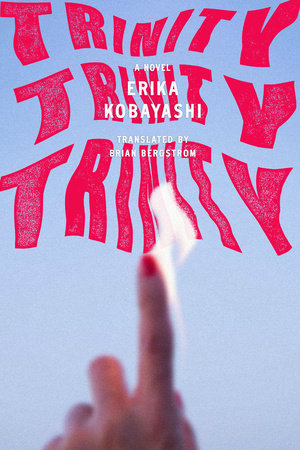
Trinity, Trinity, Trinity

A Novel

Translated by Brian Bergstrom
Look inside
Hardcover
5.81"W x 8.56"H x 0.9"D   | 12 oz | 20 per carton
On sale Jun 28, 2022 | 240 Pages | 9781662601156

See Additional Formats
"Delicately weaves generations of women to the lasting wounds of nuclear destruction and the hubris of war. A unique and unforgettable novel." —Kali Fajardo-Anstine, author of Woman of Light

A literary thriller about the effects of nuclear power on the mind, body, and recorded history of three generations of Japanese women.


Nine years after the Fukushima Daiichi nuclear power plant disaster, Japan is preparing for the 2020 Tokyo Olympics. An unnamed narrator wakes up in a cold, sterile room, unable to recall her past. Across the country, the elderly begin to hear voices emanating from black stones, compelling them to behave in strange and unpredictable ways. The voices are a symptom of a disease called “Trinity.”

As details about the disease come to light, we encounter a thread of linked histories—Prometheus stealing fire from the gods, the discovery of radiation, the nuclear arms race, the subsequent birth of nuclear energy, and the disaster in Fukushima. The thread linking these events begins to unravel in the lead-up to a terrorist attack at the Japan National Olympic Stadium. 
 
A work of speculative fiction reckoning with the consequences of the past and continued effects of nuclear power, Trinity, Trinity, Trinity follows the lives of three generations of women as they grapple with the legacy of mankind's quest for light and power.
© Mie Morimoto
Erika Kobayashi is a novelist and visual artist based in Tokyo. Kobayashi creates works that are inspired by matters invisible to the eye: time and history, family and memory, and the traces often left behind in places. Her novel Breakfast with Madame Curie (Shūeisha,) was shortlisted for both the Mishima and the Akutagawa Prize and she was awarded the 44th Japan Sherlock Holmes Club Encouragement Award in 2022 for her novel His Last Bow (Kodansha) and the 7th Tekken Heterotopia Literary Prize in 2020 for her novel Trinity, Trinity, Trinity (Shūeisha).

Her first novel to be published in English, Trinity, Trinity, Trinity (Astra House) also won the the 2022-2023 Japan-U.S. Friendship Commission Prizes (JUSFC) for the English translation of Japanese literature. Sunrise: Radiant Stories, her second work of fiction to be published in English is forthcoming from Astra House in 2023. View titles by Erika Kobayashi
  • WINNER | 2022
    Japan-US Friendship Commission Prize for the Translation of Japanese Literature
Available for sale exclusive:
•     Afghanistan
•     Aland Islands
•     Albania
•     Algeria
•     Andorra
•     Angola
•     Anguilla
•     Antarctica
•     Antigua/Barbuda
•     Argentina
•     Armenia
•     Aruba
•     Australia
•     Austria
•     Azerbaijan
•     Bahamas
•     Bahrain
•     Bangladesh
•     Barbados
•     Belarus
•     Belgium
•     Belize
•     Benin
•     Bermuda
•     Bhutan
•     Bolivia
•     Bonaire, Saba
•     Bosnia Herzeg.
•     Botswana
•     Bouvet Island
•     Brazil
•     Brit.Ind.Oc.Ter
•     Brit.Virgin Is.
•     Brunei
•     Bulgaria
•     Burkina Faso
•     Burundi
•     Cambodia
•     Cameroon
•     Canada
•     Cape Verde
•     Cayman Islands
•     Centr.Afr.Rep.
•     Chad
•     Chile
•     China
•     Christmas Islnd
•     Cocos Islands
•     Colombia
•     Comoro Is.
•     Congo
•     Cook Islands
•     Costa Rica
•     Croatia
•     Cuba
•     Curacao
•     Cyprus
•     Czech Republic
•     Dem. Rep. Congo
•     Denmark
•     Djibouti
•     Dominica
•     Dominican Rep.
•     Ecuador
•     Egypt
•     El Salvador
•     Equatorial Gui.
•     Eritrea
•     Estonia
•     Ethiopia
•     Falkland Islnds
•     Faroe Islands
•     Fiji
•     Finland
•     France
•     Fren.Polynesia
•     French Guinea
•     Gabon
•     Gambia
•     Georgia
•     Germany
•     Ghana
•     Gibraltar
•     Greece
•     Greenland
•     Grenada
•     Guadeloupe
•     Guam
•     Guatemala
•     Guernsey
•     Guinea Republic
•     Guinea-Bissau
•     Guyana
•     Haiti
•     Heard/McDon.Isl
•     Honduras
•     Hong Kong
•     Hungary
•     Iceland
•     India
•     Indonesia
•     Iran
•     Iraq
•     Ireland
•     Isle of Man
•     Israel
•     Italy
•     Ivory Coast
•     Jamaica
•     Japan
•     Jersey
•     Jordan
•     Kazakhstan
•     Kenya
•     Kiribati
•     Kuwait
•     Kyrgyzstan
•     Laos
•     Latvia
•     Lebanon
•     Lesotho
•     Liberia
•     Libya
•     Liechtenstein
•     Lithuania
•     Luxembourg
•     Macau
•     Macedonia
•     Madagascar
•     Malawi
•     Malaysia
•     Maldives
•     Mali
•     Malta
•     Marshall island
•     Martinique
•     Mauritania
•     Mauritius
•     Mayotte
•     Mexico
•     Micronesia
•     Minor Outl.Ins.
•     Moldavia
•     Monaco
•     Mongolia
•     Montenegro
•     Montserrat
•     Morocco
•     Mozambique
•     Myanmar
•     Namibia
•     Nauru
•     Nepal
•     Netherlands
•     New Caledonia
•     New Zealand
•     Nicaragua
•     Niger
•     Nigeria
•     Niue
•     Norfolk Island
•     North Korea
•     North Mariana
•     Norway
•     Oman
•     Pakistan
•     Palau
•     Palestinian Ter
•     Panama
•     PapuaNewGuinea
•     Paraguay
•     Peru
•     Philippines
•     Pitcairn Islnds
•     Poland
•     Portugal
•     Puerto Rico
•     Qatar
•     Reunion Island
•     Romania
•     Russian Fed.
•     Rwanda
•     S. Sandwich Ins
•     Saint Martin
•     Samoa,American
•     San Marino
•     SaoTome Princip
•     Saudi Arabia
•     Senegal
•     Serbia
•     Seychelles
•     Sierra Leone
•     Singapore
•     Sint Maarten
•     Slovakia
•     Slovenia
•     Solomon Islands
•     Somalia
•     South Africa
•     South Korea
•     South Sudan
•     Spain
•     Sri Lanka
•     St Barthelemy
•     St. Helena
•     St. Lucia
•     St. Vincent
•     St.Chr.,Nevis
•     St.Pier,Miquel.
•     Sth Terr. Franc
•     Sudan
•     Suriname
•     Svalbard
•     Swaziland
•     Sweden
•     Switzerland
•     Syria
•     Tadschikistan
•     Taiwan
•     Tanzania
•     Thailand
•     Timor-Leste
•     Togo
•     Tokelau Islands
•     Tonga
•     Trinidad,Tobago
•     Tunisia
•     Turkey
•     Turkmenistan
•     Turks&Caicos Is
•     Tuvalu
•     US Virgin Is.
•     USA
•     Uganda
•     Ukraine
•     Unit.Arab Emir.
•     United Kingdom
•     Uruguay
•     Uzbekistan
•     Vanuatu
•     Vatican City
•     Venezuela
•     Vietnam
•     Wallis,Futuna
•     West Saharan
•     Western Samoa
•     Yemen
•     Zambia
•     Zimbabwe

CONTENTS
 
Prologue
 
SUNRISE
 
8:00
9:00
9:30
10:00
 
DAYTIME
 
12:00
12:30
13:00
 
SUNSET
 
14:00
15:00
16:30
17:30
 
Three-Person’d God
 
REFERENCES
ACKNOWLEDGMENTS
ABOUT THE AUTHOR
ABOUT THE TRANSLATOR
Prologue

Lately, even when it’s light outside, I find I can’t tell if it’s morning or evening, if the sun is coming up or on its way back down. When I force my eyelids apart to check, all I see is a wide plane of sky the color of burning.

I blink, and blink again.

Looking over from my pillow, I catch sight of a clock.

5:23

The numbers stand out clearly on its display. The clock is cheap, plastic.
The crocheted lace doily lying beneath it is more to my liking, a pineapple motif woven into its pattern.

I try to lift my hand to trace the pineapple with my finger.
But it’s heavy as lead.

And not just my hand, my whole body is heavy, encased in lead.

Lead.

It doesn’t feel like a metaphor. It feels literal, as if now I know the exact feeling of lead being poured over my whole body.

Still, I feel as though touching the lace would unlock something—would allow me to remember more than I do. I concentrate my energy into my hand. My fingers brush against something; it feels like a remote control of some sort. I grab it and notice trailing down from it a thick cord.
What does it connect to?

There’s an orange bump in its center. Some sort of button?

My hand slowly grips the control, and I use all my might to push the button.

A sudden rumbling begins, accompanied by shaking.

The ground begins to shift beneath me. The shaking sounds like the growl of a beast.

My eyes fly open, as does my mouth, as I try to scream a scream that refuses to come out.

But it’s not the ground that’s shifting.

It’s the bed. The section beneath my back and the section beneath my legs are rising at the same time.

Startled, I throw the controller away. The rumbling abates; the shaking subsides.

I look around.

All that’s visible through the window is sky.

Where is this place? Who am I?

I seem to have forgotten.

I seem to have been asleep for quite a long time.
“Trinity, Trinity, Trinity is something like a next-step in Japanese atomic literature.”
—Asian Review Of Books

"I loved Erika Kobayashi’s Trinity Trinity Trinity, so I am lining up for her collection of strange and reflective connected stories about nuclear power and its effect on Japanese people and society, especially its women."
—Karla J. Strand, Ms. Magazine

"It’s this layering that makes Kobayashi’s otherwise subtle, light-footed writing intriguing. She stacks and Tetrises themes in such a way that their meanings only become clear when seen in relation to one another — the Olympics, Nazis, Hiroshima."
—Paula Aceves, Vulture

"This compelling novel weaves together the past, the present, and a possible future in a panoply of memory, experience, and social unrest . . . examines the shifting sands of memory and interconnected identity in a fluid landscape shaped by nuclear radiation, social media, and social connection. Highly recommended."
—Henry Bankhead, Library Journal, Starred Review

"Like its title suggests, this book is an intricate braid that contains so much: eco-terror, memory and history and mythology, generations of women, nuclear trauma — the list goes on. This is Kobayashi’s first translation into English and it bodes well for what’s to come. A deeply cool, deeply good book. Radioactive, indeed."
Kelsey F., bookseller, Powell's

"Erika Kobayashi gathers world-historical, feminist, and ecological yarns to crochet a web of 'terrorist' intrigue that tugs the Tokyo Olympics completely off-course. Fast-paced, funny, and thrillingly conceptual, Trinity, Trinity, Trinity is a masterpiece from one of Japan’s most original new voices."
—Margherita Long, author of Care, Kin, Crackup: Fukushima and the Intrusion of Gaia

"Erika Kobayashi forms an intricate lacework of a narrative in Trinity, Trinity, Trinity, unflinchingly revealing patterns and symmetries in the history of nuclear warfare, radioactivity, and the unspoken emotional legacies inherited by generations of mothers and daughters. Possessing its own glowing dream-logic, this novel is dark and radiant all at once."
—Lee Conell, author of The Party Upstairs

"Erika Kobayashi’s compelling new novel explores the nuclear trauma of the 20th and 21st centuries through the code name Trinity: the site of the detonation of the first atomic bomb, an allusion to a poem by John Donne, and the appearance of a strange disease, also called Trinity. Interweaving the lives of three generations of women, Kobayashi effectively combines history, memory, and forgetfulness in a gripping narrative that this reader could not put down. A major contribution to contemporary Japanese fiction by an important new author."
—Janice Carole Brown, author of Tarnished Words: The Poetry of Ōba Minako

"Erika Kobayashi’s brilliant novel Trinity, Trinity, Trinity traces the everyday, yet ghostly, technologies, and the invisible forces, that shape our lives, acts, and epoch. A luminous and penetrating history of our shared present—a history felt on the body, across generations and around the world. Incandescent and indispensable, this is a stunning work by a visionary artist and writer."
—Mark Seltzer, author of The Official World

"Trinity, Trinity, Trinity is a heartfelt and poignant novel about the aftermath of disaster. Erika Kobayashi brilliantly layers memory and oblivion, fear and doubt, destruction and recovery via the 2020 Tokyo Olympics and the Fukushima nuclear accident in a story that is hauntingly reminiscent of the COVID-19 Pandemic. Stunning and unforgettable."
—J.M. Lee, author of Broken Summer

"Reading Trinity, Trinity, Trinity by Erika Kobayashi is like entering a universe beating with a deeply intelligent light. Kobayashi delicately weaves generations of women to the lasting wounds of nuclear destruction and the hubris of war. A unique and unforgettable novel."
—Kali Fajardo-Anstine, author of Woman of Light

"Trinity, Trinity, Trinity encloses the reader in a terrifying world undreamed of by the irrational. Humans reduced to themselves, their solitude and incompleteness, make their way cautiously through a world of ordered disequilibrium. Kobayashi writes with an ironic potency that illuminates the actual at every mysterious point."
—Susanna Moore, author of In the Cut

About

"Delicately weaves generations of women to the lasting wounds of nuclear destruction and the hubris of war. A unique and unforgettable novel." —Kali Fajardo-Anstine, author of Woman of Light

A literary thriller about the effects of nuclear power on the mind, body, and recorded history of three generations of Japanese women.


Nine years after the Fukushima Daiichi nuclear power plant disaster, Japan is preparing for the 2020 Tokyo Olympics. An unnamed narrator wakes up in a cold, sterile room, unable to recall her past. Across the country, the elderly begin to hear voices emanating from black stones, compelling them to behave in strange and unpredictable ways. The voices are a symptom of a disease called “Trinity.”

As details about the disease come to light, we encounter a thread of linked histories—Prometheus stealing fire from the gods, the discovery of radiation, the nuclear arms race, the subsequent birth of nuclear energy, and the disaster in Fukushima. The thread linking these events begins to unravel in the lead-up to a terrorist attack at the Japan National Olympic Stadium. 
 
A work of speculative fiction reckoning with the consequences of the past and continued effects of nuclear power, Trinity, Trinity, Trinity follows the lives of three generations of women as they grapple with the legacy of mankind's quest for light and power.

Creators

© Mie Morimoto
Erika Kobayashi is a novelist and visual artist based in Tokyo. Kobayashi creates works that are inspired by matters invisible to the eye: time and history, family and memory, and the traces often left behind in places. Her novel Breakfast with Madame Curie (Shūeisha,) was shortlisted for both the Mishima and the Akutagawa Prize and she was awarded the 44th Japan Sherlock Holmes Club Encouragement Award in 2022 for her novel His Last Bow (Kodansha) and the 7th Tekken Heterotopia Literary Prize in 2020 for her novel Trinity, Trinity, Trinity (Shūeisha).

Her first novel to be published in English, Trinity, Trinity, Trinity (Astra House) also won the the 2022-2023 Japan-U.S. Friendship Commission Prizes (JUSFC) for the English translation of Japanese literature. Sunrise: Radiant Stories, her second work of fiction to be published in English is forthcoming from Astra House in 2023. View titles by Erika Kobayashi

Awards

  • WINNER | 2022
    Japan-US Friendship Commission Prize for the Translation of Japanese Literature

Table of Contents

CONTENTS
 
Prologue
 
SUNRISE
 
8:00
9:00
9:30
10:00
 
DAYTIME
 
12:00
12:30
13:00
 
SUNSET
 
14:00
15:00
16:30
17:30
 
Three-Person’d God
 
REFERENCES
ACKNOWLEDGMENTS
ABOUT THE AUTHOR
ABOUT THE TRANSLATOR

Excerpt

Prologue

Lately, even when it’s light outside, I find I can’t tell if it’s morning or evening, if the sun is coming up or on its way back down. When I force my eyelids apart to check, all I see is a wide plane of sky the color of burning.

I blink, and blink again.

Looking over from my pillow, I catch sight of a clock.

5:23

The numbers stand out clearly on its display. The clock is cheap, plastic.
The crocheted lace doily lying beneath it is more to my liking, a pineapple motif woven into its pattern.

I try to lift my hand to trace the pineapple with my finger.
But it’s heavy as lead.

And not just my hand, my whole body is heavy, encased in lead.

Lead.

It doesn’t feel like a metaphor. It feels literal, as if now I know the exact feeling of lead being poured over my whole body.

Still, I feel as though touching the lace would unlock something—would allow me to remember more than I do. I concentrate my energy into my hand. My fingers brush against something; it feels like a remote control of some sort. I grab it and notice trailing down from it a thick cord.
What does it connect to?

There’s an orange bump in its center. Some sort of button?

My hand slowly grips the control, and I use all my might to push the button.

A sudden rumbling begins, accompanied by shaking.

The ground begins to shift beneath me. The shaking sounds like the growl of a beast.

My eyes fly open, as does my mouth, as I try to scream a scream that refuses to come out.

But it’s not the ground that’s shifting.

It’s the bed. The section beneath my back and the section beneath my legs are rising at the same time.

Startled, I throw the controller away. The rumbling abates; the shaking subsides.

I look around.

All that’s visible through the window is sky.

Where is this place? Who am I?

I seem to have forgotten.

I seem to have been asleep for quite a long time.
Praise

“Trinity, Trinity, Trinity is something like a next-step in Japanese atomic literature.”
—Asian Review Of Books

"I loved Erika Kobayashi’s Trinity Trinity Trinity, so I am lining up for her collection of strange and reflective connected stories about nuclear power and its effect on Japanese people and society, especially its women."
—Karla J. Strand, Ms. Magazine

"It’s this layering that makes Kobayashi’s otherwise subtle, light-footed writing intriguing. She stacks and Tetrises themes in such a way that their meanings only become clear when seen in relation to one another — the Olympics, Nazis, Hiroshima."
—Paula Aceves, Vulture

"This compelling novel weaves together the past, the present, and a possible future in a panoply of memory, experience, and social unrest . . . examines the shifting sands of memory and interconnected identity in a fluid landscape shaped by nuclear radiation, social media, and social connection. Highly recommended."
—Henry Bankhead, Library Journal, Starred Review

"Like its title suggests, this book is an intricate braid that contains so much: eco-terror, memory and history and mythology, generations of women, nuclear trauma — the list goes on. This is Kobayashi’s first translation into English and it bodes well for what’s to come. A deeply cool, deeply good book. Radioactive, indeed."
Kelsey F., bookseller, Powell's

"Erika Kobayashi gathers world-historical, feminist, and ecological yarns to crochet a web of 'terrorist' intrigue that tugs the Tokyo Olympics completely off-course. Fast-paced, funny, and thrillingly conceptual, Trinity, Trinity, Trinity is a masterpiece from one of Japan’s most original new voices."
—Margherita Long, author of Care, Kin, Crackup: Fukushima and the Intrusion of Gaia

"Erika Kobayashi forms an intricate lacework of a narrative in Trinity, Trinity, Trinity, unflinchingly revealing patterns and symmetries in the history of nuclear warfare, radioactivity, and the unspoken emotional legacies inherited by generations of mothers and daughters. Possessing its own glowing dream-logic, this novel is dark and radiant all at once."
—Lee Conell, author of The Party Upstairs

"Erika Kobayashi’s compelling new novel explores the nuclear trauma of the 20th and 21st centuries through the code name Trinity: the site of the detonation of the first atomic bomb, an allusion to a poem by John Donne, and the appearance of a strange disease, also called Trinity. Interweaving the lives of three generations of women, Kobayashi effectively combines history, memory, and forgetfulness in a gripping narrative that this reader could not put down. A major contribution to contemporary Japanese fiction by an important new author."
—Janice Carole Brown, author of Tarnished Words: The Poetry of Ōba Minako

"Erika Kobayashi’s brilliant novel Trinity, Trinity, Trinity traces the everyday, yet ghostly, technologies, and the invisible forces, that shape our lives, acts, and epoch. A luminous and penetrating history of our shared present—a history felt on the body, across generations and around the world. Incandescent and indispensable, this is a stunning work by a visionary artist and writer."
—Mark Seltzer, author of The Official World

"Trinity, Trinity, Trinity is a heartfelt and poignant novel about the aftermath of disaster. Erika Kobayashi brilliantly layers memory and oblivion, fear and doubt, destruction and recovery via the 2020 Tokyo Olympics and the Fukushima nuclear accident in a story that is hauntingly reminiscent of the COVID-19 Pandemic. Stunning and unforgettable."
—J.M. Lee, author of Broken Summer

"Reading Trinity, Trinity, Trinity by Erika Kobayashi is like entering a universe beating with a deeply intelligent light. Kobayashi delicately weaves generations of women to the lasting wounds of nuclear destruction and the hubris of war. A unique and unforgettable novel."
—Kali Fajardo-Anstine, author of Woman of Light

"Trinity, Trinity, Trinity encloses the reader in a terrifying world undreamed of by the irrational. Humans reduced to themselves, their solitude and incompleteness, make their way cautiously through a world of ordered disequilibrium. Kobayashi writes with an ironic potency that illuminates the actual at every mysterious point."
—Susanna Moore, author of In the Cut
Penguin Random House Comics Retail