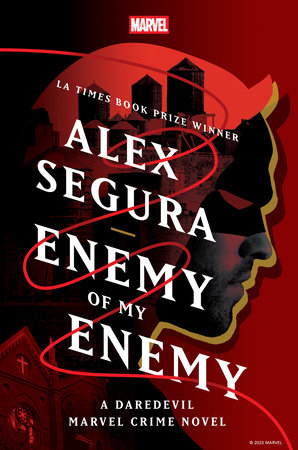
YOU COULD HEAR a pin drop.The expression was apt, but it meant little to Matthew Murdock. Not just because the words were clichéd, but because for Matt hearing an actual pin drop was akin to the crack of a baseball connecting with a wooden bat, or a car door slamming. Matt could hear a pin drop in the middle of rush hour traffic.
Still, Matt thought, a normal human could hear a pin drop in the Lower Manhattan courtroom where he made his way toward the jury box to present his closing argument in a case that had consumed his working hours for what felt like an eternity. Matt scanned his long thin white cane a few paces ahead of him and stopped a few feet in front of the jury box. Blind since childhood, he couldn’t see the eyes of the jury on him, but he could sense their stares.
Matt was now a renowned New York City defense attorney, resident of Hell’s Kitchen, and frequent gossip column target, but it was never clear that he would make it this far in life. When as a child he’d been blinded by some chemicals while pushing an elderly man out of a runaway truck’s path, he had lost his ability to see in the traditional sense.
And even before the accident, Matt’s world had been constrained. Matt’s father—“Battlin’” Jack Murdock—was a local legend in the gym and in the ring and didn’t want his only son to end up an addled bruiser like him. No fighting, no roughhousing: Those were the aging boxer’s rules. Nothing mattered more to Jack than ensuring his son got out of the slums and made something of himself. And so Matt was forced to stay home—always studying, always reading, always stuck inside their tiny, cramped West Side apartment.
“People of the jury,” Matt said, his voice echoing in the large courtroom. “Let me speak plainly. Jason Thomas is a criminal. That is a matter of record. He assaulted a man years ago. He stood trial. He was found guilty of that crime and served his time. But that alone is not evidence enough to prove that Mr. Thomas is guilty of this murder—of the brutal killing of Stephen Goldsmith. As a jury, it’s your job to look beyond what Mr. Thomas has done with his life and focus on the evidence of the crime in front of you. The evidence is what matters most. Is Thomas a bad man? Has he done bad things? It’s possible—but is it relevant to this case before you?”
Matt knew Jason Thomas was innocent. Unlike most defense attorneys—who would prefer not to know and just put up the best defense they could muster—Matt couldn’t help it. A few minutes into their first conversation, in an NYPD precinct interview room, Matt knew. He could tell based on Thomas’s demeanor, his heart rate, and how his breathing stayed focused. He left the meeting with Thomas knowing two things: that his client was innocent, and that Matt would have a hard time winning the case.
Matt’s certainty about his client’s innocence came from the unexpected benefit he’d gained as a result of the runaway truck and the toxic materials it carried. Nearly every sense Matt had was enhanced to a superhuman level. Which was why even from across a table, his client’s heartbeat and breathing patterns told Matt the man was not lying when he professed his innocence and asked for the famed lawyer’s help. While his vision was permanently lost in the accident, Matt had been “gifted” with a radar sense—a kind of 360-degree sensory experience that allowed him to picture shapes and figures if not their inherent visuals. Not distracted by certain details, he could read the body language of Mr. Thomas, and it backed up his sense that the man was truly innocent.
Abilities aside, innocent or no, Matt knew getting Mr. Thomas acquitted would be difficult. Matt had worked in the trenches of the New York criminal system for years. Certainly, the evidence against his client was slight: There was surveillance footage of a heated exchange between Thomas and Goldsmith outside a Hell’s Kitchen bodega the night before the victim was found stabbed in his Midtown penthouse. A motive was nonexistent. However, Goldsmith was a beloved social media personality known for his glib takes on city life, whereas Thomas was an ex-con who lived in the Bronx. Goldsmith was white and rich; Thomas was poor and Black. Matt knew the odds created by the legal system, and they were stacked against his client. To many people, it was an open-and-shut case. In situations like this, Matt had to do a lot of work to overcome a jury’s default assumptions and get them to see the facts at hand.
As Matt took another step forward, he could hear a woman in the public gallery mouthing an apologetic resignation email. He could smell the strawberry-flavored candy the security guard two courtrooms over was sliding into his mouth. Most importantly, he could hear the rhythmic, nervous pounding of juror number seven’s heartbeat right in front of him.
Matt Murdock knew these abilities gave him an advantage. To be able to hear when someone was lying on the stand was certainly a benefit no attorney in their right mind would ignore. By registering a judge’s metabolism rate, he could sense when they were having an unconscious reaction to something in their courtroom. Such powers came with great responsibility, and Matt knew this. Because Matt Murdock, first and foremost, was a believer in the justice system. He respected the rule of law. But if Matt could help an innocent victim beat a bad rap—or prevent an all-too-common systemic injustice from repeating itself—then he didn’t see using his sensory powers as a cheat. He saw it as the scales of justice coming into some semblance of balance. He was a man with amazing abilities, and there was no law against him using them to make the world a little fairer.
But even that wasn’t always enough.
One of the jurors in the back row cleared his throat, a loud, soggy sound to Matt’s ears. He could sense the older female juror in front of him blinking furiously. Heartbeats were picking up speed. Breathing was coming in and out faster from the twelve bodies before him. It all told Matt one thing—they were listening. And they
believed.
Matt turned his head away from the jury slightly, allowing him to pick up the sounds behind him. One sound in particular. His opponent, Assistant District Attorney Harry Tremins, was a nice enough guy—outside the courtroom. But when trial day came, he was a shark. Tremins was not afraid to push boundaries or a judge’s patience; it seemed—to Matt at least—that his main goal was to anger the defense in the hopes that they’d show their cards and slip up in some way. He wanted to rattle his opponents, because rattled opponents made mistakes.
But Matt Murdock wasn’t some fresh-out-of-law-school guppy. For years, high-profile cases like this had been his career.
Well, his daytime career.
Matt’s life was conflicted, to say the least. By day, he was Matt Murdock, respected and capable defense attorney, willing to take big cases to help those less fortunate. Though paying rent for their Midtown Manhattan offices was a struggle more often than not, Matt and his best friend and law partner, Foggy Nelson, had built a reputation as the kind of lawyers you wanted on your side—the kind of attorneys big corporations and bad people feared. It was not rare for cases to be quickly settled once the other side discovered their opponents had put Nelson & Murdock on retainer. No one wanted a drag-out fight with them.
But the evenings were a different story, for Matt and for Hell’s Kitchen.
Few stories of the dark side of Hell’s Kitchen rang as true as that of his father. Battlin’ Jack Murdock was a relic—an aging boxer who’d long ago dropped below the list of title contenders. Not nearly as quick as he once was, Battlin’ Jack had become, to some, a joke. He’d lingered too long—a twisted and battered fossil who was barely hanging on. The promoters weren’t calling. The fans weren’t cheering. The fights weren’t happening. Jack Murdock, despite the lies he told his college-age son Matt, was on the brink of losing it all.
The Fixer knew that. A mid-level gangster who spent most of his time managing his outfit’s sports betting operation, the lanky, mischievous Fixer liked to put his finger on the scale of his bets to keep the money flowing. And in Battlin’ Jack Murdock, he saw a big finger. People loved a comeback, and considering where Jack Murdock was, a comeback was all he had in him. He made Murdock an offer he had to accept.
Ashamed but also desperate to keep his son in college and his lights on, Jack said yes. And the Fixer’s promise proved true—suddenly Battlin’ Jack Murdock was back in the spotlight, winning some unexpected upsets and clawing his way onto the radar of local boxing gatekeepers. It was a story fans loved—an aging, washed-up fighter pushing for one last shot at the title. Even Matt remembered being in awe of it.
But it was a fraud. And all frauds soon come to light.
The call didn’t surprise Matt when it came, around three in the morning. His father had been found dead—battered to death—in an alley near the ring where he’d just experienced his greatest glory. The police had no evidence or suspects, and didn’t expect to get any—it was clearly a mob hit. As Matt processed what the detective was saying, he could almost see the man shrug through the phone.
What did surprise Matt was that he already knew what he was going to do about it.
Because, as a kid, Matt hadn’t listened to Battlin’ Jack or his rules. Sure, he’d studied and kept to himself, but on the frequent nights when his dad wasn’t home, at a fight or off drinking or sleeping away a hangover, Matt trained. He trained at the very gym where Jack himself went. Though blind, Matt’s gift of radar sense, and his heightened hearing, smell, touch, and taste, made him a formidable sparring partner, if he was able to reveal himself. Matt trained in
secret—avoiding the fighters and tough-talkers that frequented the gym as he perfected the fighting skills he knew he’d need. But for what? He wasn’t sure.
So when Matt got that three a.m. call—he was ready. He just hadn’t known it yet.
Jack Murdock was dead.
But Daredevil had been born.
And a different kind of justice would walk the streets and corners of Hell’s Kitchen.
“People of the jury . . .” Matt Murdock said again, shifting his weight from one foot to the other as he mulled over his next sentence. The speech Matt was about to utter in the courtroom was critically important. The wrong phrase could send his client to prison forever.
The right words could save this man’s life.
Copyright © 2026 by MARVEL. All rights reserved. No part of this excerpt may be reproduced or reprinted without permission in writing from the publisher.