A scientifically-precipitated, out-of-control tale of evolution set in Antarctica—it predates Lovecraft’s At the Mountains of Madness—by a mathematician of note who also wrote science fiction.
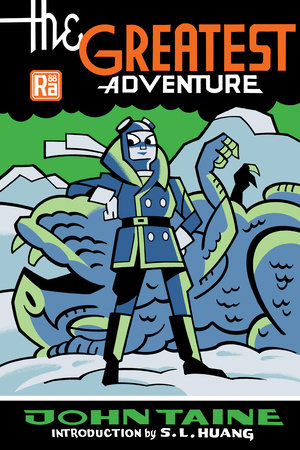
In The Greatest Adventure, an expedition to Antarctica discovers remnants of an elder race with advanced technology. These ancients had discovered the secret of developing new life-forms . . . but when the mutations threatened to run amok, their creators entombed their entire civilization in ice. Intrepid aviatrix Edith Lane and her comrades must flee through caverns inhabited by the mutated monsters, and when frozen spores begin to thaw out, the planet is threatened by malign plant life. The Greatest Adventure is a tale of horror by John Taine—the pseudonym of mathematician Eric Temple Bell—that is not without moments of humor.
S. L. Huang is a Hugo-winning, bestselling author who justifies an MIT degree by using it to write eccentric mathematical superhero fiction. Huang is the author of the Cas Russell novels from Tor Books, including Zero Sum Game, Null Set, and Critical Point, as well as the new fantasies Burning Roses and The Water Outlaws.
Eric Temple Bell (1883–1960) was a mathematician who taught at the California Institute of Technology. The eponym of Bell polynomials and Bell numbers of combinatorics, his 1937 book Men of Mathematics would help to inspire Julia Robinson, John Forbes Nash, Jr., Andrew Wiles, and other future mathematicians. Writing as “John Taine,” he published many proto-sf novels.
Series Foreword - Joshua Glenn Introduction: Science Wonder Stories - S.L. Huang 1 Bird or Reptile? 2 Captain Anderson’s Story 3 A Puzzle for Drake 4 The Riddle of the Rocks 5 “Battles Long Ago” 6 A Witness to the Truth 7 Beached 8 A Significant Hint 9 Into It 10 Undaunted 11 Hot Water 12 Trapped 13 Hades 14 The Devil Chick 15 Anticipations 16 Attack 17 At Close Quarters 18 The Enemy 19 Attacked 20 Desperate
"What makes the Radium Age series so valuable is how it illuminates the origins of science fiction tropes we take for granted. The Greatest Adventure reveals the literary DNA of Lovecraft's cosmic horror." —Boing Boing
“The Greatest Adventure is both a rousing adventure and a pioneering work of environmental fiction reflecting concerns over extractivism, the role of science in warfare, and the future of scientific inquiry.” —Siobhan Maria Carroll, Associate Professor, University of Delaware
“A mixture of H. Rider Haggard, Conan Doyle, Roy Chapman Andrews, and a bottle of excellent gin.” —California Tech (1929)
A scientifically-precipitated, out-of-control tale of evolution set in Antarctica—it predates Lovecraft’s At the Mountains of Madness—by a mathematician of note who also wrote science fiction.
In The Greatest Adventure, an expedition to Antarctica discovers remnants of an elder race with advanced technology. These ancients had discovered the secret of developing new life-forms . . . but when the mutations threatened to run amok, their creators entombed their entire civilization in ice. Intrepid aviatrix Edith Lane and her comrades must flee through caverns inhabited by the mutated monsters, and when frozen spores begin to thaw out, the planet is threatened by malign plant life. The Greatest Adventure is a tale of horror by John Taine—the pseudonym of mathematician Eric Temple Bell—that is not without moments of humor.
Creators
S. L. Huang is a Hugo-winning, bestselling author who justifies an MIT degree by using it to write eccentric mathematical superhero fiction. Huang is the author of the Cas Russell novels from Tor Books, including Zero Sum Game, Null Set, and Critical Point, as well as the new fantasies Burning Roses and The Water Outlaws.
Eric Temple Bell (1883–1960) was a mathematician who taught at the California Institute of Technology. The eponym of Bell polynomials and Bell numbers of combinatorics, his 1937 book Men of Mathematics would help to inspire Julia Robinson, John Forbes Nash, Jr., Andrew Wiles, and other future mathematicians. Writing as “John Taine,” he published many proto-sf novels.
Series Foreword - Joshua Glenn Introduction: Science Wonder Stories - S.L. Huang 1 Bird or Reptile? 2 Captain Anderson’s Story 3 A Puzzle for Drake 4 The Riddle of the Rocks 5 “Battles Long Ago” 6 A Witness to the Truth 7 Beached 8 A Significant Hint 9 Into It 10 Undaunted 11 Hot Water 12 Trapped 13 Hades 14 The Devil Chick 15 Anticipations 16 Attack 17 At Close Quarters 18 The Enemy 19 Attacked 20 Desperate
Photos
Praise
"What makes the Radium Age series so valuable is how it illuminates the origins of science fiction tropes we take for granted. The Greatest Adventure reveals the literary DNA of Lovecraft's cosmic horror." —Boing Boing
“The Greatest Adventure is both a rousing adventure and a pioneering work of environmental fiction reflecting concerns over extractivism, the role of science in warfare, and the future of scientific inquiry.” —Siobhan Maria Carroll, Associate Professor, University of Delaware
“A mixture of H. Rider Haggard, Conan Doyle, Roy Chapman Andrews, and a bottle of excellent gin.” —California Tech (1929)